

Examining Winthrop’s unclear stance on AI art.
By Kyan Feser
Staff Writer
Arts, Culture & Technology
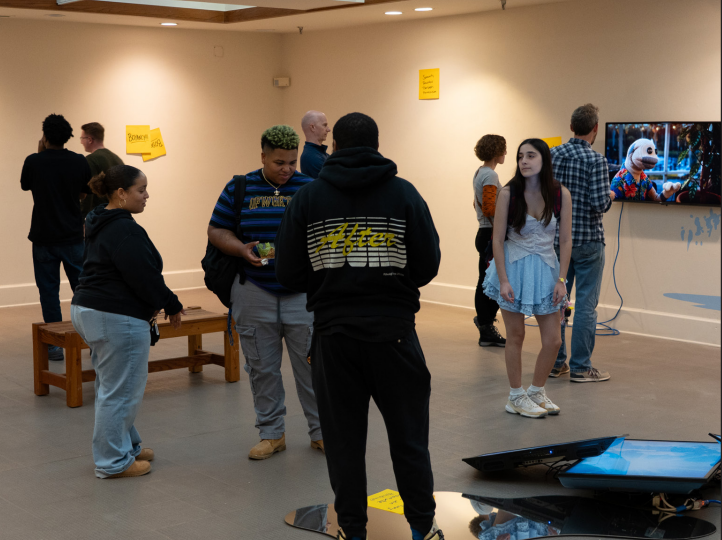
Debuted on Oct. 26 in Winthrop’s Elizabeth Dunlap Patrick Gallery, “What’s Above Gary?” is the latest art installation by Rebecca Forstater, an interdisciplinary artist and assistant professor at Wofford College in Spartanburg, S.C.
The gallery is centred around the titular Gary, an anthropomorphic sock puppet who is “getting lost to the bots, and maybe is a bot,” according to Forstater.
“He gets lost in this world of the internet, and he’s trying to find his way out through the sky,” Forstater said.
Massive, garbled Post-it notes line the gallery’s walls; the ceiling is plastered with images of a digital sky and most importantly, a television loops an AI-generated video of Gary’s mundane, internet-centric life.
Because of this video, and subsequently Gary’s design, “What’s Above Gary?” is one of the first galleries to prominently use AI at Winthrop, something Forstater expected mixed reactions to. “I’m on the internet,” she said jokingly.
“I was expecting there to be some interesting questions, but I think that is the point of art, right? To be a place where we can have those difficult conversations and have them be talked about without the constraints of other external factors,” Forstater said.
During a discussion panel on Nov. 12, Forstater said that her research into how money, data and imagery are exchanged in digital spaces deeply influenced “What’s Above Gary?”. She said she wanted to examine how, despite being made for the few, emerging technologies like AI are forced into everyday life.
Forstater further explained how “What’s Above Gary?” questions AI perceptions, such as perceived environmental impact or what actually determines artistic value. To test these ideas, she trained a dataset locally and catalogued the length of the overall project.
In the end, there was little impact on her electric bill and the project actually took “a really long time,” she said.
“You can be critical and curious at the same time, and sometimes I think that’s the best way to understand something: is to explore it,” Forstater said. “Allowing yourself to understand opposing viewpoints encourages nuance, as opposed to initial gut reactions.”
However, not everyone shares the same sentiments as Forstater, as “a lot of students are really upset about it,” said Mars Simpson, a Winthrop fine arts senior and co-founder of the Rising Artists of Winthrop club.
Simpson said a major concern among students is how deregulated AI seems within the galleries, and the precedent “What’s Above Gary?” could set for them. If Winthrop greenlit Forstater’s work for the gallery, then a senior’s handmade exhibition is comparable to something generated.
“One of the concerns is how an AI senior show and a handmade senior show are going to be comparable in terms of both students paying for the same degree, and I don’t think the department has thought of that or an answer to that, which is concerning,” Simpson said.
Additionally, students in the fine arts department are given failing grades for AI use, but the department is currently promoting an AI exhibition, implying that generating art is a probable way to secure a gallery spot at the university, Simpson added.
“Getting inside of a university gallery is a big deal to a lot of us fine arts majors. So, being told that putting together a complete AI exhibition is okay, but then failing us for using AI, there’s a lot of conflict there,” Simpson said.
The Winthrop student artist said this conflict has only worsened student-director tensions in the department, as last year three art pieces, including one created by Simpson, were removed from the undergraduate juried exhibition due to nudity.
“Nudity is very accepted in art. So why was it not ok to put it in the Undergraduate Juried Exhibition? The gallery director told me that he couldn’t put nudity in this show because it would upset the donors,” Simpson said.
Simpson said that the gallery’s controversy is being viewed as a positive sign by the gallery director and others in the Winthrop art department.
“The gallery director and everyone else involved said that, I quote, ‘because the students are so upset that must mean that they’re engaged with the exhibition. Therefore it must be a good exhibition,’” Simpson said.
“That really bothered me to hear that upsetting the donors because of nudity is completely off limits, and he just pulled work from the show to not upset donors, but when students are upset about AI, it’s seen as a unit of measurement for success.”