

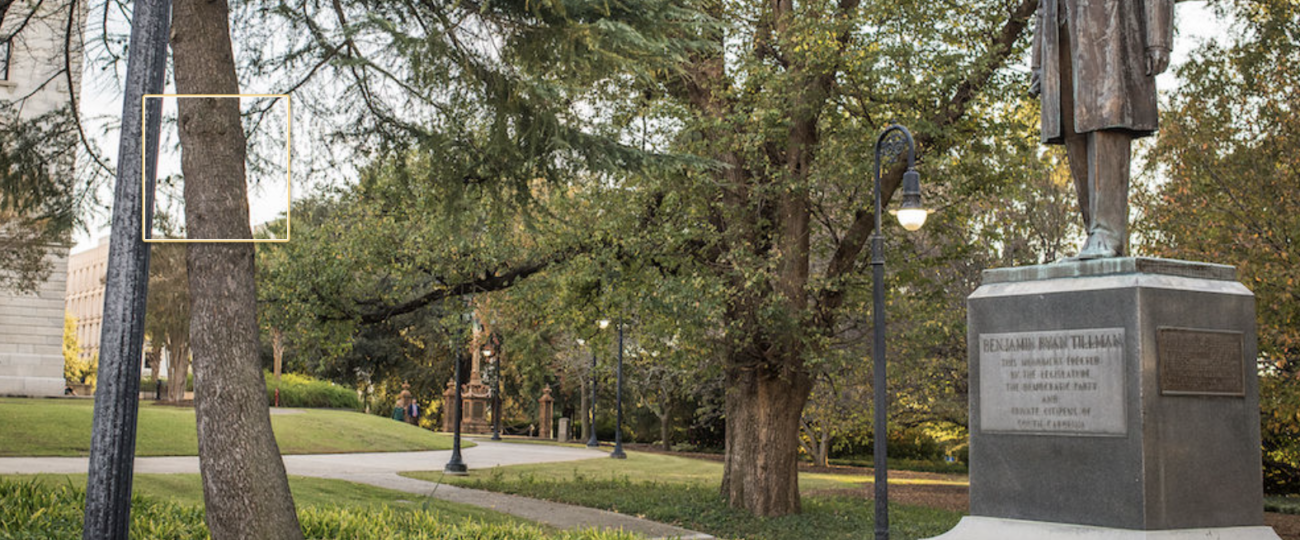
Senate Bill 508 was sent to the State House earlier this month, proposing a bad on the removal or renaming of historical monuments and sites, as well as the addition of new plaques and QR codes.
Evi Houston
News Editor
Photo by John Carlos – Statue of Ben Tillman
The South Carolina Senate voted in support of a bill which expands protections of historical monuments on April 15, passing the bill on to the State House. Senate Bill 508 prevents any removal of monuments or memorials of historical significance. This also applies to the renaming of streets, buildings, and government buildings referencing a historical figure.
The law would also ban the installation of modern plaques or QR codes to provide information on said monuments, a first in the nation according to the Associated Press.
Protected monuments include those that reference any major conflict the United States or South Carolina has been involved in, including the Civil War. The bill makes clear that no “historic monuments or memorials erected on public property of the State or any of its political subdivisions may be relocated, removed, disturbed, or altered.”
Any removal requires the approval of the General Assembly.
Much of the debate around monument protection comes back to differing perceptions of the Civil War and Confederate monuments. A perceived threat of anti-Confederate sentiment may have prompted the support of Republican sponsors of the bill.
In almost poetic language, the bill begins, “Accounts written by people who experienced the event — or who lived closer to the time period — carry the texture of context, language, and lived reality that inevitably fades with time. The nearer a person stands in time to the event, the more likely their description reflects the conditions, perceptions, and meanings as they were actually understood when they occurred.”
These historical musings are not without political connotations, according to Dr. Scott Huffmon, professor of political science at Winthrop University and director of the Winthrop Poll,
Huffmon, who has published work on the significance of the Confederate flag and Confederate monuments in public opinion, provided his expertise to The Johnsonian on the politics of monument protection
In a red state like South Carolina, Huffmon argued that Senate Bill 508 is a product of competition within the conservative party to get the attention of voters.
“When it comes to these things, partisanship has become more important than race,” Huffmon said.
Today, liberal-conservative differences over Confederate monuments are more significant than Black-White differences, despite the relevance of race to the Civil War.
“This is less of a battle about race, […] less of a battle about heritage, which is the argument, and more a battle about identity,” Huffmon said.
Protection of historical monuments has become incorporated into national conservative attitudes, regardless of someone’s physical or familial connection to the South. Huffmon noted that even though South Carolina has experienced substantial population growth, outsiders bring sentiment about the Confederacy with them.
When asked about the possible motivations behind proposing S 508 in today’s political climate, Huffmon cited three major factors: political polarization, anti-DEI attitudes, and the upcoming Republican primaries.
Polarization between parties in the United States has led to major distrust of the opposing side. Voters and lawmakers feel that any concession they make, such as the removal of a Confederate statue, will compromise their values.
This aligns with the Senate vote on the bill, in which “All those who voted for it were Republicans, while all those who voted against it were Democrats,” according to the Associated Press. 31 senators voted in support and seven voted against.
Attacks of DEI policies, or “Diversity, Equity and Inclusion,” since 2024 have trickled down to the state level. Huffmon sees the bill as a logical continuation of these attitudes.
Lastly, and perhaps most effective in explaining the timeliness of the bill, is the upcoming Republican primaries. Since it is expected that most state house districts guarantee a Republican win, primaries are the critical time to outdo fellow conservatives.
“We’re super majority Republican, so for most of them, your only threat is somebody from the further right […] so you have to establish your conservative bona fide credentials within the party,” Huffmon said.
Sponsoring a bill like S 508 is one way conservative lawmakers may attempt to do this, symbolically asserting their protection of Republican identity.
Given Huffmon’s interest in the subject, it is no coincidence that questions about the Confederate flag and Confederate monuments are almost always featured on the Winthrop Poll.
When comparing Winthrop Poll results from November 2022 to November 2025, the most recent poll of SC residents, there is little shift in public opinion on what to do with Confederate monuments.
Support for leaving Confederate monuments with no alterations has stayed just above 30% for all polls conducted in the last three years.
Support for leaving the monument in place but adding a plaque to provide historical context has grown in popularity, from 28% to 36%, as support for moving the monuments to a museum has decreased.
Support for completely removing the monuments has consistently stayed below 10%, meaning that the most popular option among SC residents is the alteration of the monument with a modern plaque, something S 508 would ban.
“Plaques, markers, and anything that facilitates the transmission of messages through digital or electronic means” which are not original to the monument or memorial are prohibited by the bill.
This silences any new interpretation of the history behind the monument, and typically protects the conservative viewpoint.
The bill is therefore “trying to prevent people from contextualizing history from a modern frame,” Huffmon said.
A final notable addition to S 508 is the legal standing provided to “affinity organizations and monument preservation organizations,” allowing groups such as the United Daughters of the Confederacy to file a civil suit against the state of South Carolina should they find this necessary.
This further entrenches the state’s support of the monuments and memorials, expanding the Heritage Act and symbolically communicating its support of conservative values.