
Dr. Helen Davis and other, active research on multispectral imaging and the importance of technology in the humanities.
Gabriela Griggs
AC&T Editor
Photo By Zoey Molina
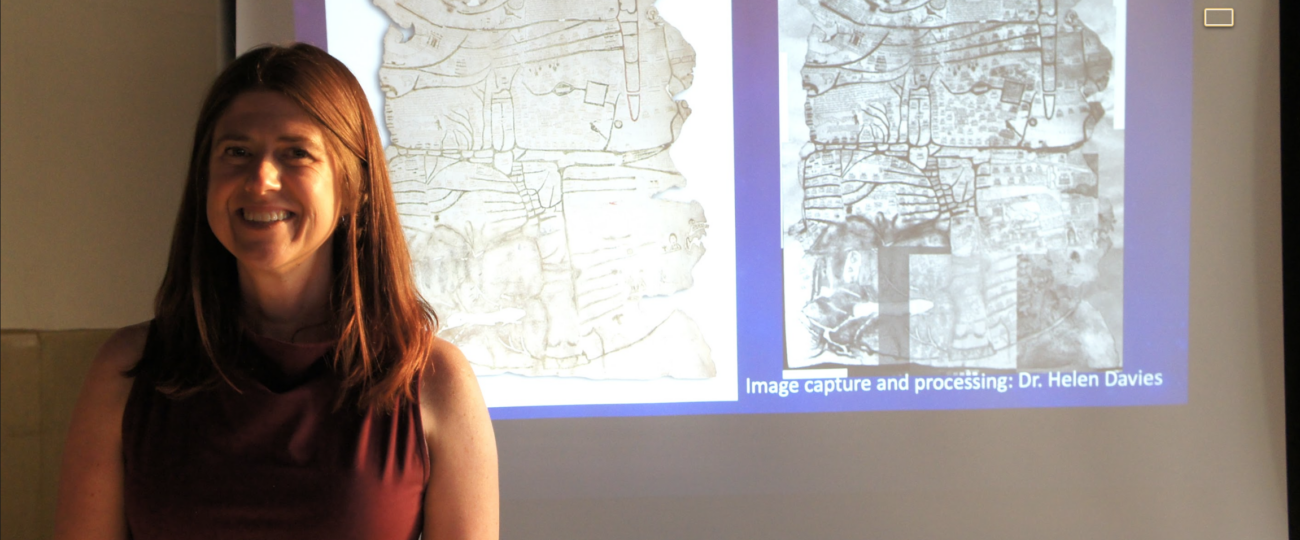
Dr. Helen Davies from UNCC in front of her presentation
On April 23, Dr. Helen Davies, a professor at University of North Carolina at Charlotte, came to Winthrop’s campus to deliver a lecture surrounding her work in the digital humanities, as well as multispectral imaging.
Multispectral imaging, also known as MSI, is a method of information detection that uses multiple wavelengths, such as infrared, visible light, and ultraviolet, to capture and analyze images and maps beyond what is visible to the human eye.
“I work on multispectral imaging to recover lost, damaged and illegible cultural heritage objects. My research focuses mostly on recovering medieval maps, but I use this technology for documents far beyond the medieval in my work,” Davies’ website says.
The development of multispectral imaging has begun to reveal both details and text in medieval manuscripts and maps that were previously unseen, simply because the human eye doesn’t have the capability to view these details.
A project established with the University of Colorado at Colorado Springs by Davies called “Illuminating the Past,” aims to do exactly that: give “citizen scholars” an opportunity to get their hands on MSI technology, specifically Davies’ developed technique called the “Ghost Camera.” This allows anyone interested in interacting with this technology to also get hands-on experience working with artifacts and the process in developing and managing an MSI project.
Another active project Davies’ research contributes to is the “Lazarus Project,” dedicated to changing the future of how scholars study “cultural heritage objects” and manuscripts.
“The Lazarus Project is an interdisciplinary initiative that brings together experts in the sciences and the humanities to recover the lost stories of our collective past and fill in the gaps in the record of human knowledge. Like the Hubble telescope that peers back through eons to reveal the remotest origins of the universe, the Lazarus Project uses cutting-edge technologies, such as spectral imaging, to discover universes of hidden knowledge in the damaged and overwritten pages of medieval manuscripts, the faded surfaces of old maps, the cryptic drawings on cave walls, and the inscriptions on ancient artifacts. Our task is to use science to see the invisible, read the illegible, visualize the obscure, conserve the past, and educate the present,” the project’s website states.
Since the development of the Lazarus Project, they’ve worked with major museums across the world, including the New York Public Library, the National Library of Wales and the Folger Shakespeare Library, among others. Currently, the project trains students at the Rochester Institute of Technology (RIT).
MSI technology is also being actively developed and used at RIT through a program called “Multispectral Imaging System for Historical Artifacts,” also known as MISHA, which was mentioned by Davies during her talk in McBryde.
“The MISHA system […] comprises three elements: the light source; the camera, sensor, lens, and the platform and housing for image capture. Employing the capacity of multispectral imaging to divide the light spectrum into frequency bands and to record these independently, MISHA uses 16 light emitting diodes (LEDs), with each capture using a specific wavelength ranging from the ultraviolet to the visible and the near infrared,” the RIT website states.
A significant aspect of the use of MSI technology is not just the ability to utilize light to develop and reveal “undertext,” a term used to describe aspects of images, texts, and maps that are found with MSI, but the ability to completely maintain the state of these artifacts. MSI doesn’t involve the retouching or altering of these artifacts to find undertext, but simply makes it visible.
“We employ a cutting-edge, fully transportable multispectral imaging laboratory to capture images of a manuscript or cultural heritage object, then use digital processing techniques to recover texts and images lost for centuries due to damage or deliberate erasure. Our methods are entirely non-destructive and non-invasive, and produce archival-quality images ready for study or digitization,” The Lazarus Project website states.
Davies, during her visit to Winthrop, used MSI technology on multiple manuscripts held in the Louise Pettus Archives, aiding in her goal to make the technology accessible to smaller institutions.
“Multispectral imaging has traditionally been an expensive process reserved for the most prestigious of medieval manuscripts. I am working to expand the technology beyond the boundaries of research libraries and private universities. My approach advocates for the use of accessible, open-access technologies for image capture and processing. I aim to expand the archive so that traditionally overlooked documents and people can be included and highlighted in the historical record,” Davies’ website states.
MSI technology is used across the world to discover new aspects of artifacts, texts, paintings, maps, and other objects. Scholars like Davies work towards making this technology more and more accessible to students and educational institutions, preventing discovery from being limited by financial statuses and access to technology.