
Rock Hill region picked 14 state legislators on Election Day to represent the Columbia region.
By Ta’Ni Miller
News Editor
News
South Carolina’s general election took place on Nov. 3, with early voting from Oct. 19 to Oct. 31. This included the nationwide midterm election, with voters picking a senator, governor, along with various state seats.
The U.S. Senate and the House of Representatives were ruled by majority Republican seats following the second term presidential election of Donald Trump in 2024.
Democrats have looked to flip the seats blue within both areas.
The Rock Hill region includes three counties of York County, Lancaster County and Chester County.
Registered voters of these three regions voted for a total of 14 seats in Columbia, with one seat being for the Senate and 13 for the House of Representatives.
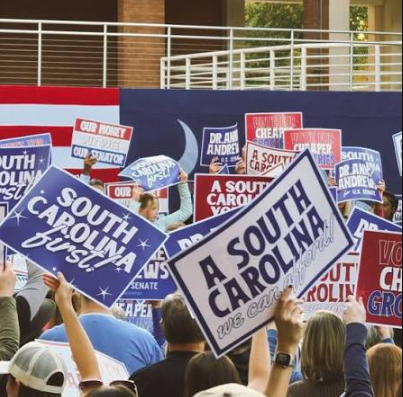
Democrat Dr. Annie Andrews won the U.S. Senate election and Republican Alan Wilson won as Governor, with Mike Reichenbach as Lieutenant Governor.
With Dr. Annie Andrews’ win, the state of South Carolina has flipped blue within the Senate for the first time since 1998.
York County and Chester County had a majority vote for Dr. Annie Andrews, with Darline Graham winning in Lancaster County.
Senate Dist. 15 elected Republican candidate James Burns, who won the seat that serves the center of York County and a large portion of Rock Hill.
Democrat elected pick John King ran unopposed on the ballot for the Dist. 49 seat.
Clubs and organizations on campus have been encouraging students to be informed about the midterm election, fighting the common stigma that college students are not engaged with politics.
Midterm elections follow a recurring trend of having less turnout than the presidential election. Many voters remain uneducated about the impact of midterm and state elections.
Some classes have even given extra credit to students who are registered to vote and who went out to vote in this election. William Schulte, mass communication professor at Winthrop University, gave out additional points if students showed photo proof of both.
This included showing proof of voting registration through physical card or website screenshot and a photo taken at the polls. Higher points were awarded if a student went with a friend or family member.
One organization that advocates for voting within both state and federal elections is Winthrop Votes.
Voting ambassadors of this organization share information to students through social media such as Instagram on how to apply to vote, absentee voting, general voting information amongst other key facts.
Justin Feaser, senior marketing major, is the founder of Winthrop Votes and was inspired to create the organization in his sophomore year at Winthrop. After seeing a lack of voting initiative on campus, he became focused on how to connect with Gen Z voters across campus.
“A slogan I’ve always used is ‘meeting Gen Z at eye level.’ To bring voting awareness to students, you have to speak their language. Millennials and Gen Xers don’t understand that, so myself and other voting ambassadors have a unique angle and appeal to hopefully attract college voters.” Feaser said. “This would include “street-style” interviews, consistent posts, video promotions, and raffles.”
Feaser accounted that he saw a decline in voting interest for this current midterm cycle compared to when he first founded the organization in 2024 during the presidential election.
“Speaking to classes about voting this year versus in 2024 is like night and day… what was once met with genuine interest started to be met with confusion or boredom. South Carolina broke several voting records this year, though, so I think my perspective might be in the minority.” Feaser said.
Students interested in learning more about voting initiatives on campus can follow the official Instagram @winthrop_votes for more information.