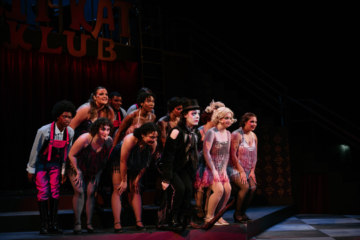


Closing February with the first theatrical performance of the semester and comments from members involved, including newcoming director, Dr. Marvin McAllister.
Gabriela Griggs
AC&T Editor
Sydney Meetze
Staff Writer
AC&T
The opening performance of “The Escape; or, A Leap for Freedom,” first released in 1858, was performed on the evening of Feb. 25 at the Johnson Theater. The play, written by writer and abolitionist William Wells Brown, follows the story of two enslaved lovers who secretly marry before making a desperate attempt to gain their freedom.
“The Escape” is widely considered to be the first play published by an African American writer. Though the play was published during the playwright’s lifetime, it was never performed in full while he was still living. Instead, W. W. Brown gained attention for his play by performing excerpts at abolitionist rallies and other public events.
Upcoming performances of “The Escape” are an adaptation of the original work, meaning there have been complex efforts from director and professor Dr. Marvin McAllister beyond those of a typical production.
“I think the most unique part of the adaptation has been highlighting and doing justice to the three different performance traditions W.W. Brown is playing with in his original,” McAllister said. “The first two traditions were blackface minstrelsy and melodrama, which were very popular in the mid-19th century. The third is anti-slavery oration, which is kind of an antidote to degradation of blackface, and featured ‘professional fugitives’ like W.W. Brown telling their stories all over the world.”
Beyond protecting the traditions held at the core of “The Escape,” navigating language is another challenge faced by McAllister, who has been teaching the play throughout his career.
“The most challenging part of the adaptation was the language,” McAlister said. “Specifically, [figuring] out the right combination of blackface minstrel dialect and normal Black speech for the time. Brown’s original has [most of] the Black characters… speak in a blackface minstrel version of Black speech the entire [time], I didn’t want to put that on young 21st century actors, so I cleaned up the speech when the enslaved characters are speaking amongst themselves. Also, with language, nearly all of the white characters in the original play, use the N-word… so I had to find a way to get the essence of the word in there without [having] young white students actually say the word.”
“I have been teaching W.W. Brown play, in its original form and as an adaptation, for almost 30 years. Over these many years, students have discussed and written about this play from so many angles. I have learned from these students what this play is really about. I literally learned how best to adapt the original play based on student, in-class reactions to the material,” McAllister said.
Recognizing the work put into making “The Escape” raises questions about why this work in particular was chosen for performance, instead of selecting a piece inherently more optimized for production without such hands-on work from those involved.
“In choosing this work, I wanted [a] piece that challenged our acting students to do something other than realism. Something more presentational than representational, because it requires different acting and performance muscles. It requires a greater separation [between] actor and role,” McAllister said. “I also wanted to do a larger cast show to involve more people, especially actors who don’t typically get to be in mainstage shows. Related, I was looking for a show that had Black stories at the center, but included white actors, so we wouldn’t cut off half of the actors in the department. I [also] wanted a piece with historical weight that could honor and celebrate Black History Month. This campus doesn’t [seem] to do much with Black History month, I hope that can change.”
Students involved in the production, such as senior stage manager and filmmaker Ethan Ganzell and sophomore cast member Kai Brooks, also had much to say about their individual experiences with putting this production in motion.
“This show has been very different from other shows I’ve worked on in the Winthrop theatre department in a lot of ways,” Ganzell said. “The biggest difference is that the director, Dr. McAllister, has never directed with this theatre department before. [Since] WU produces shows so regularly and often with the same staff members, there’s been a routine that has developed over time. Working with someone who isn’t as aware of that routine has opened the door to us doing things a little differently than usual.”
“I am extremely proud of the whole escape team,” Brooks said. “Being part of this production has been a, for a lack of better words, a weird journey. So many new learning techniques, like the Meisner technique or grid work, [have] now been engraved in my acting self. I’ve built a lot of relationships within this cast and for that I’m extremely grateful.”
“The Escape” has walked on to the Winthrop stage during a tense time in United States politics, which is something that has not gone unnoticed by production members like Brooks and Ganzell.
“The things that are currently going on in the world [are] incredibly heartbreaking, and I think this story reflects that,” Brooks said. “While we are in a hard time, in the end, [we] will fight and win against all odds. I think it’s also important to showcase this production during black history month, [and] as a black actor this story connected to me on a different level. Knowing that this is based off a true story makes this not only a story, but a lens to [see] the reality of the situation.”
“The Escape is really the most unique show I’ve seen produced by Winthrop Theatre since I enrolled in the fall of 2023,” Ganzell said. “It’s probably the most collaborative I’ve seen a director be with students. The script itself is just so unique. A question that Dr. McAllister presents to his students in the classroom is ‘why this play now?’ which creates an understanding of why older plays are still relevant to us today. Out of Winthrop Theatre’s 2025-26 season, The Escape has the most obvious answer to that question.”
The final performance of the show will be held on March 1. “It [has been] incredibly interesting to dive into the history of minstrel performance. There’s so much to learn from it [,] and at the start it had such an unsettling feeling to it. Questions went through my head like ‘Should I laugh?’ or ‘Am I portraying this correctly?’ When watching this production I think it’s important to keep an open mind, to listen thoroughly, and don’t be afraid to laugh!”