

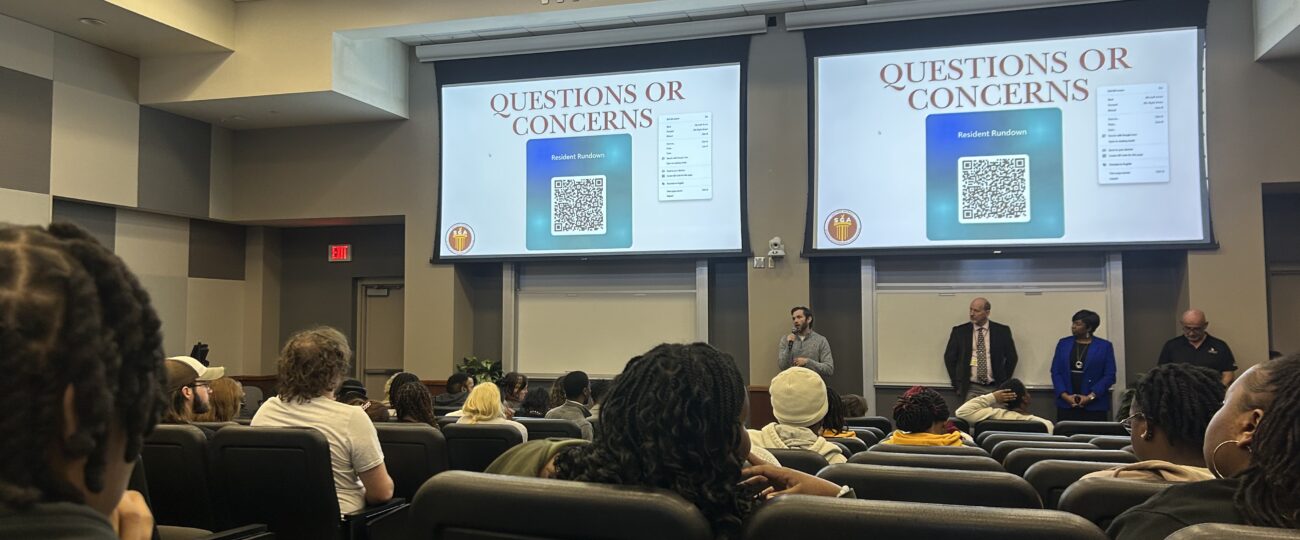
Students shared their perspective through protest and the Student Government Association’s Residence Rundown Town Hall last week, expressing frustration over the lack of housing for upperclassmen on campus.
Evi Houston
News Editor
News
Students at Winthrop University have continued to voice their frustration since the University’s announcement in late January that juniors and seniors would not be guaranteed housing and would need to move off-campus next semester. This announcement blindsided many upperclassmen and has created transportation and financial strains which may interfere with their academic career.
In response to these concerns, Winthrop University’s Student Government Association partnered with administrative figures to host The Residence Rundown Town Hall on Feb. 17. On their panel was Jarad Russel, James Grigg, Kevin Butler, and Sheila Burkhalter.
Notably, the Town Hall did restrict students from freely asking their questions and used an online form to submit questions. All questions asked were chosen and asked by the SGA based on their level of appropriateness. Some students still shouted out questions to the front of the auditorium, to no response.
On the morning of the event, some students protested the University’s handling of the housing crisis on Campus Green to voice their concerns. Some protesters even brought their signs into the Town Hall to communicate directly with the administration.
Brianna McGriff, a junior majoring in sociology, joined the housing protest because she felt misled by the University, who previously advertised that housing would be provided to upperclassmen and then changed course. This decision has personally impacted her plans for the following year.
“I think that Winthrop should have been better prepared for a bigger freshman class and were not taking into account students who live far away,” McGriff said.
McGriff also attended the Town Hall, which she said helped her understand the University’s thought process but was not what she expected.
“It did leave me feeling a lot more frustrated because they weren’t answering a lot of the questions [I had]. I feel like they could have addressed things better,” McGriff said.
How we got here
Vice President of Student Affairs Sheila Burkhalter explained the housing crisis as a consequence of rebounding rather than overenrollment. The incoming class of 2030 is comparable to admissions numbers in 2018, a sign of health for the university, according to Burkhalter.
Burkhalter noted that since the COVID-19 pandemic, upperclassmen have established a trend of staying on campus, which the University adjusted to by leasing out Walk2Campus apartments. The panelists expressed that they had exhausted all possible housing solutions, meaning students must look elsewhere.
“It became very clear, even with the 500 bed spaces in Campus Walk, we were not going to be able to house a large number of students,” Assistant Dean of Students and Director of Residence Education Jarad Russell said at the Town Hall, discussing the University’s decision making process at the end of 2025.
Discussions on housing began in October but were not finalized until January. After partnering with Apartment and Corporate Relocation Services, or ACRS, the University communicated their predicament to students on Jan. 27.
The numbers
During an executive committee meeting for the Board of Trustees on Feb. 12, Burkhalter shared how bed spaces will be split among the student body for the upcoming academic year.
In total, the University has 2,122 available bed spaces. An estimated 1,100 freshmen will take up these spaces next year, along with 871 sophomores. 129 of the remaining beds will be reserved for “operational hold”.
Burkhalter’s calculations then leave 22 beds for upperclassmen for the 2026-27 academic year. This is in stark contrast to the 451 upperclassmen who have expressed a need for housing and joined the University’s waitlist as of Feb. 12.
“We’re positioning ourselves to be able to manage as many people on that waiting list as possible and give them an opportunity to live on campus,” Burkhalter said.
Exempting rising sophomores from the two-year residency requirement is one strategy the administration hopes to use to open up more bed spaces for upperclassmen, but this has also not proved viable in numbers. On Feb. 12, only 33 students had requested to live off-campus for their sophomore year.
Winthrop’s reasoning
Burkhalter said the housing decision is a sacrifice needed to maintain the profitability and stability of Winthrop University, so that investments can be made into student life on campus. This requires a growing freshmen class and, temporarily, the elimination of housing for upperclassmen.
“We have people in our midst right now whose institution closed because of a lack of enrollment, and that meant that their institution could not survive financially,” Burkhalter said. She shared how the university was at risk of closing following the pandemic, if enrollment numbers had not started to increase.
The speaker recognized that this decision will have a personal effect on students and require trade-offs, although she hopes the University will prepare all students for success.The University feels it must prioritize Freshman and Sophomores so that they can adjust and mature, trusting that upperclassmen are more prepared to handle off-campus living.
“We have done our best […] to make sure that we could house you for as long as we could,” Burkhalter said.
State of on-campus housing
When asked about issues with current student housing, such as mold and water damage, Vice President of Facilities James Grigg said that his team is working diligently to address maintenance issues, even when this requires hard decisions.
“Just because you see something does not immediately mean mold is dangerous and a concern,” Grigg said. This was responded to with frustration and grumbling among the students present.
Students also asked about why the University tore down Richardson and Wofford Hall, two high-rise residence halls formerly facing Cherry Road. Grigg cited roof slab issues and water damage which potentially compromised the structure of Wofford Hall.
The state provided funding to demolish both buildings, although Grigg admits that only one hall had pressing structural issues. Due to past estimates of enrollment and maintenance issues with the building, saving Richardson Hall was no longer seen as necessary.
“Could we have envisioned that our enrollment would grow as rapidly as it has since then? No, no we didn’t, but now we’re in that process of trying to replace those buildings,” Grigg said.
In addition to losing Wofford and Richardson Hall, Russell shared that Roddey Hall will be closed next year, as the building puts a strain on Facilities Management and has” outlasted its lifespan by multiple years.”
The university is focused on planning a new residence hall which will be ready for students during the Spring 2028 semester, according to current estimates. “Once that’s up, we hope to be able to bring as many juniors and seniors back onto campus that wish to live on campus,” said Russell.
The University is still in the process of selecting a contractor for the hall and will not break ground until the summer of 2027.
Solutions for students
Administrators cited student misunderstandings and a lack of education as a central problem with the housing crisis. Burkhalter shared this when meeting with the Board, explaining that affordability was not an issue if students were able to properly use their financial aid.
When asked about the use of outside scholarships on housing, rather than federal financial aid, Burkhalter claimed there to be no difference in terms of funding for students. “The resources that are used to pay for on campus housing will also be available to pay for off campus housing,” she said.
Russell discussed different options for upperclassmen, including using ACRS to simplify the moving process, living at The Nest apartments, or finding another nearby apartment and sharing a room.
“There are dozens of apartment complexes in the area, you’re looking at $1,200 to $1,700 split between four people, that’s going to end up being much cheaper than on campus housing,” Russell said.
ACRS has been promoted as a resource to find safe and affordable housing and ease transitions off campus, such as through bundling utilities. The service is funded by apartment complexes seeking to advertise their building.
Russell responded to questions about transportation issues for students by saying “Rock Hill is unique in that it has a city bus system that is completely free, and the routes go pretty much everywhere in Rock Hill.” He views this as a “viable option” for students living off campus without a car.
The panel was unresponsive to providing more commuter parking, arguing that there is enough parking, it is just not always in the places and of the nature that students would like.
There is no designated staff member to assist upperclassmen with housing, although the Board of Trustees is open to this idea. Students are welcome to meet with Residence Life for support at this time.
What’s to come
The panel was asked directly about the likelihood of upperclassmen students getting on-campus housing next semester.
“I’m not expecting a huge number of spaces [for upperclassmen],” Russell said. The only potential chance of getting housing comes from sophomores choosing to live off campus, which would then allow for juniors and seniors to be pulled in from the waitlist.
Juniors and seniors will begin receiving waitlist notifications on March 1, but this process can only ensure housing for some students and will be given to those with the most credit hours.
Russell clarified that no exceptions would be made for any groups who need housing, including honors students and those asking for accommodations. Only those in their first and second years at Winthrop University (including transfer students) can be guaranteed housing.
Housing for juniors and seniors will remain an ongoing issue as the university continues to expand. “It will likely bleed into the following years, until we can get the new residence hall fully up and running,” Russell said.