
A night of lion dancing and performances emphasize the importance of cultural awareness.
Zachary Bell
Managing Editor
AC&T
Students gathered in Richardson Ballroom to celebrate the Lunar New Year in a festive night filled with dance, music, and delicious food.
The DiGiorgio Student Union (DSU), along with the Asian American Pacific Islander Organization (AAPI), hosted the event. Marcus Gonzalez, President of the DSU, spoke about the Lunar New Year’s role in promoting cultural awareness among Winthrop students.
“If we’re going to want to be better as people, we have got to be willing to see different aspects of life. It’s just about making people aware. All this stuff makes America the United States of America.”
The Lunar New Year is an ancient tradition celebrated in many Asian communities. Unlike the Western Gregorian calendar that revolves around the solar cycle, the Lunar New Year is based on the lunar cycle.
This year, the Lunar New Year’s celebration falls on February 17, marking the year of the Fire Horse. Students received lucky red envelopes at the door that symbolize joy and good fortune.
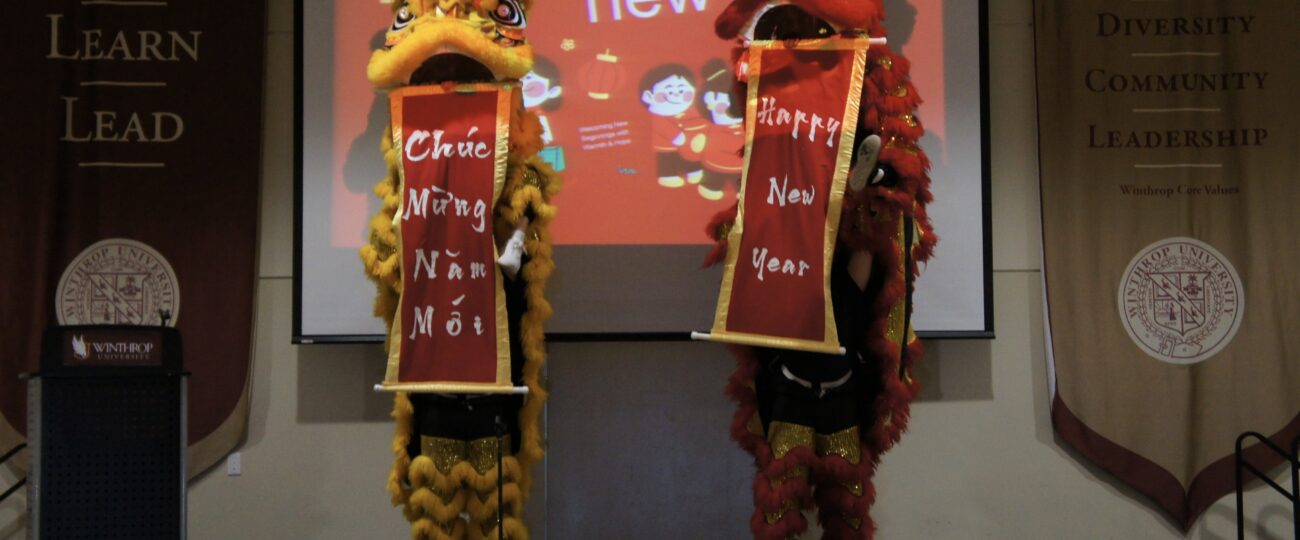
The festival opened with a thrilling performance by the Queen City Lion Dance team. Dressed in traditional gold and red lion costumes, the performers danced to the rhythm of a vigorous drumbeat, kicking and leaping around the ballroom in a display that is believed to bring good luck.
Vinh Tran, one of the performers with Queen City Lion Dance, talked about the cultural significance of the lion dance.
“We almost embody the animal itself. We are trying to ward off the evil spirits. It’s believed in our culture that these animals provide that protection. They prepare you and your family for the New Year.”
Tran, a Vietnamese American, learned about lion dancing from his youth group at the age of seven. Today, he educates himself and others on the importance of lion dancing.
“I just hope that [the students] have a great time watching the show. But I also hope that they get to learn a little about our Asian culture and Vietnamese tradition.”
Although the Lunar New Year originated in China 3,000 years ago, many different Asian cultures observe the Lunar New Year. Serena Eow, Chair of the Lectures and Diversity Committee at the DSU, grew up with a family that celebrated the Lunar New Year. Hosting an event offered a new perspective on the festivities.
“Hosting it here, especially on a University campus, brings a different perspective. People might have heard of it but never witnessed it,” Eow said. “You can say it’s an eye-opening experience for me as well. I’m learning to embrace how other people celebrate the Lunar New Year.”
It was through hosting this event that Eow learned that Cambodians celebrated the Lunar New Year. Representatives from the Cambodian Legacy Project spoke to students about Cambodian culture and festivals.
The Cambodian Legacy Project started their presentation with two dances. A 12-year-old girl performed an original dance that incorporated pieces of her Cambodian heritage and ballet experience.
“She is half-white and half-Cambodian,” said Eow. “The dance she created incorporates ballet and traditional Cambodian dance. This [dance] is her way of embracing both sides of herself. She’s accepting both the white part of her, and the Cambodian part of her.”
For Kaovny Jonas, the CEO and Co-Founder of the Cambodian Legacy Project, it is important for people to embrace all parts of their identity. Jonas herself is Chinese, Cambodian, and American.
“I don’t see myself as divided,” Jonas said. “I see myself as a bridge.”
Jonas painted a vivid picture of Lunar New Year celebrations in the Cambodian capital of Phnom Penh, the quiet streets and incense burnt in honor of their ancestors. Dance, according to Jonas, is not just about entertainment: It’s a symbol of cultural resilience that keeps a historical legacy alive.
This year’s festival was an emotional moment for Gonzalez after last year’s Lunar New Year celebration had to be canceled due to budget cuts.
“I was disappointed when we couldn’t do it last year,” said Gonzalez. “But we made up for it with this great turnout and these amazing people.”
For Austin Guo, a Junior, it is important that Winthrop continues to support cultural celebrations on campus. “They bring everyone out. There’re all these different backgrounds, and these events open people’s perspectives more.”
This year’s festivities became more than a celebration of the Lunar New Year. Through food, music, and dance, students were reminded of the many cultures that shape Winthrop’s community.