
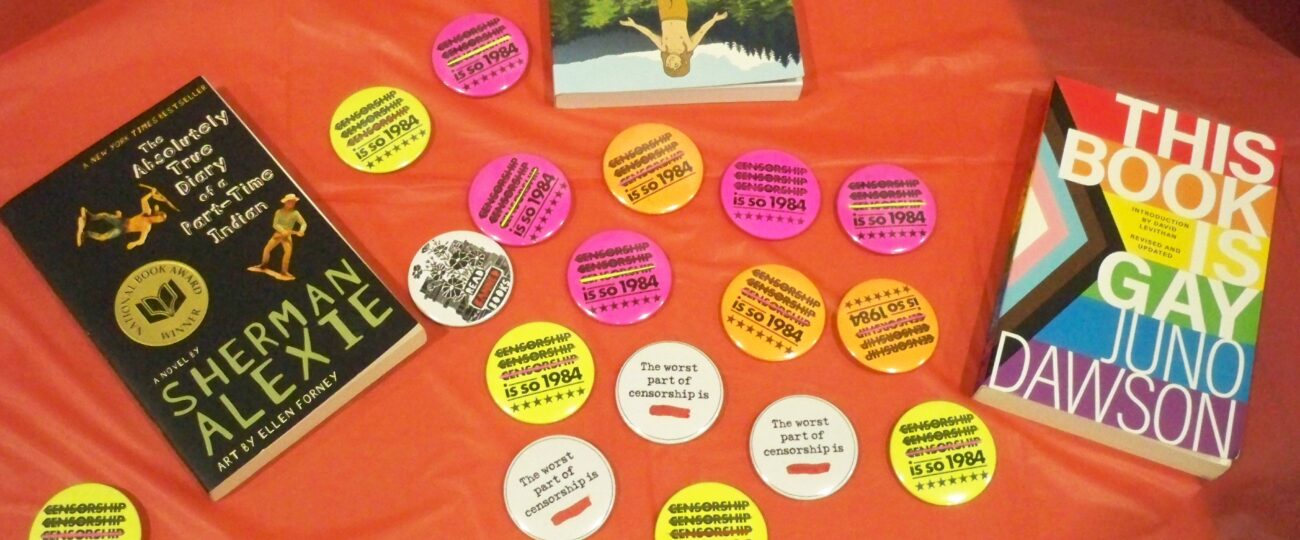
The English department hosted event discussed the current state of book bans, and students who attended the event shared their thoughts on it with the Johnsonian.
By Riley Brodie
AC&T Editor
Caroline Smith
Staff Writer
On October 7th, Winthrop University’s English department partnered with the Literary Society to hold the 14th Annual Banned Book event on campus.
The event opened with a game of trivia, followed by multiple presentations regarding SC Legislation and banned books led by Dr. Amanda Hiner, Dr. Casey Cothran, and Dr. Amanda Campbell. A few of the specific books covered included “This Book Is Gay” by Juno Dawson, “A Court of Thorns and Roses” by Sarah J. Maas, and “Nineteen Minutes” by Jodi Picoult.
According to the ACLU, South Carolina currently leads the nation in state-mandated book bans, with a total of 22 removed or restricted books in K-12 public schools.
In 2024, The American Library Association reported that, “Pressure groups and government entities (. . .) initiated 72% of demands to censor books in school and public libraries.” Parents accounted for 16% of censorship demands and library users accounted for only 5% .
The American Library Association additionally stated that most frequent censorship demands were in regards to, “false claims of illegal obscenity for minors; inclusion of LGBTQIA+ characters or themes; and covering topics of race, racism, equity, and social justice.”
Multiple event attendees and members of the Literary Society Executive board took the time to discuss their thoughts on book bans and censorship.
Khalia Williams, a junior elementary education major and president of the Literary Society, questioned the reasoning for book bans in South Carolina.
“In South Carolina, books must be up for review and, almost certainly, banned if they contain any “sexual content”; this begs the question of what exactly fits into these parameters. Is it just explicit sex scenes, or does it target sexuality as a whole, gender, identity, and other topics that children are exploring? I think we know the answer.”
Williams also shared a personal sentiment regarding the topic.
“When I was growing up, books helped me to find myself. Books helped me to love the skin I’m in while living in an area where there weren’t many people who looked like me. Books helped me explore my sexuality and understand that I’m not wrong or confused,” Williams said.
Kayli Thorsen, a junior integrated marketing communications major and vice president of the Literary Society, echoed similar views.
“Sir Francis Bacon is famously attributed as saying that ‘knowledge is power.’ Attempts by pearl-clutching bureaucrats and hate-filled reactionary groups like Moms for Liberty to ban books in schools and libraries are a direct threat to both the knowledge and power of the American people,” Thorsen said.
“For many people from poor or uneducated backgrounds, public schools and libraries are a primary source of knowledge that cannot be gained in any other place. That is why protecting the freedom of these institutions from censorship is so important. Banning books keeps people ignorant and powerless.”
Thorsen also discredited a common misconception regarding the topic at hand.
“Many college students do not believe that book banning and censorship will strongly impact them because they are adults whose educational content is less restricted than K-12 students. This is not true – a lack of knowledge and a deliberate withholding of information is concerning for everyone. A less educated and well-read population causes many issues for society, such as widespread poor decision-making, ignorance, and prejudice. The best cure for problems like racism, sexism, and homophobia is a good education, especially one starting at a young age.”
Similarly, Williams pointed out how censorship has consequences for students at Winthrop.
“Censorship affects us. We learned at the Banned Books Event that our own Dacus library has a few titles up for review and possible removal. College students tend to think that since we’re adults now, we don’t have to worry about censorship and restrictions, yet here we are,” Williams said.
Aneley Johnson, a junior sociology major and social media manager of the Literary Society, holds similar views about censorship as Williams and Thorsen.
“We learn from the past and from others’ opinions and experiences: the information we learn from others keeps us from repeating past mistakes. Knowledge helps us challenge and criticize those in power, while censorship aims to prevent us from critically thinking and challenging those in power. Everyone has the right to knowledge, as it teaches us empathy and rights and wrongs,” Johnson said.
Johnson shared her love for the commonly banned book, “Animal Farm,” and the possible implications it has on government regulation.
“This was the first book about government I read in middle school. ‘Animal Farm’ specifically taught me that the government doesn’t always have your best interest in mind. When there is an injustice within a system, you have the right to stand up and reject that system, even if it causes pain,” Johnson said.
Multiple attendees of the Banned Book Event explained their favorite banned books.
Sofia Weihrauch, a sophomore, said, “My favorite banned book is “[The] Perks of Being a Wallflower” as it feels very raw in its description of growing up with mental health issues and trauma. The main character is navigating through high school, friendship, love and loss and I find the discussion of these in the book to be important and relatable for many.”
Freshman Cadyn Bagley said, “I really appreciate “Flamer” by Mike Curato. It shows the experience of closeted teens in 1995 and I think that perspective for queer closeted children is really unique.”
Bagley also shared a notable testament regarding the harmful impact of book bans.
“I used to work at a library that had to remove books from shelves all the time. I saw many books with diverse main characters get removed, and it broke my heart. I hated that the future kids would not be able to read about experiences they might run into as a human in this world. So I can say without a doubt, I hate book bans.”
If you are interested in learning more about banned books and books in general, consider joining the Literary Society. They host bi-weekly meetings on Mondays at 6:30 p.m., facilitating various literature-related activities. For more information, follow @wu_literarysociety.
https://www.aclusc.org/en/press-releases/south-carolina-now-leads-nation-state-mandated-school -book-bans