
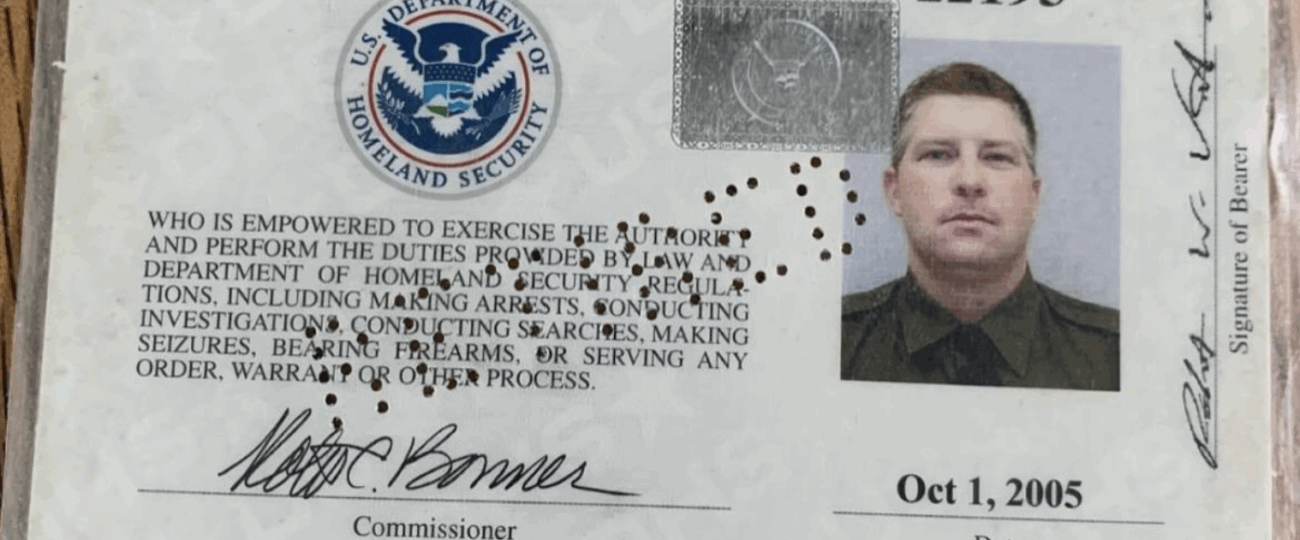
Robb Victor, a Border Patrol agent for 22 years, talks about life in border patrol, standout moments during his career and his thoughts on the job.
Summers in Arizona can see the temperature rise as high as 115 degrees Fahrenheit. Now imagine staying in a house with no electricity, no running water and just a bucket to use the bathroom.
That’s the site former border patrol agent Robb Victor came across once during his 22 year career, and while it was certainly memorable, it’s not for the reason most people would think.
After letting the migrants in the house to sit in the shade when one asked, another border patrol agent wasn’t too pleased with this.
“My partner that day, who was [a few] years junior to me, said, ‘No, no, they stay here. They stay here on the hot sidewalk. They’re here illegally. They don’t deserve the shade.’ And I told him, ‘dude, they’re human beings. They get shade. They’re going to sit over here,’” Victor said.
Victor almost couldn’t believe something as minor as getting shade would rile someone up that much, but it’s not uncommon.
“There’s no need to disrespect the Eighth Amendment just because you have a grudge on the people you arrested, or you have some personal vendetta against Hispanics, or maybe you are Hispanic and think you’re a better Hispanic than the migrants. Believe me, there’s plenty of Hispanic agents that can be cruel to migrants. It’s not just white and black agents,” Victor said.
This cruelty, as Victor put it, was something he knew couldn’t be changed by one man on the inside. But he hoped to bring some decency to the position and at least set an example for others.
“I remember [my mom] had a bumper sticker on her car and it said ‘no human being is illegal.’ So mom, during that time in her life, asked me a straight up question. I told her, ‘Mom, I’ve applied for the Border Patrol.’ And she asked, ‘Son, can’t you find a noble career?’ And I replied, ‘Well, Mom, can’t I bring nobility to the career?’” said Victor. “I think I have, I think I did for 22 years.”
Border patrol work was not Victor’s first career choice though.
In 1999, Victor was working in Mississippi as a juvenile probation counselor while finishing his master’s in sociology at Jackson State University.
Once learning just how little the master’s mattered for his career at the time, he immediately pivoted.
“My title was youth court counselor and I made $21,500. My boss told me I was going to go up to $23,000-something with the masters and I thought, ‘you know, I have to earn more than $23,000-24,000 a year.’ So I applied for a federal law enforcement criminal investigator [position],” Victor said.
While Victor passed the US Marshal Service exams (the minimum score is a 70%), he was the only one in his group to score below a 90%.
That’s when he found out about border patrol.
“I joined the border patrol on September 20, 1999 in Tucson, Arizona. They had us in a conference room, and we all swore to uphold the Constitution and to the oath of office, and we became Border Patrol agents,” Victor said.
Shortly after, Victor and the rest of his group trained at the Federal Law Enforcement Training Center in Charleston, South Carolina, in order to get their badges.
In the lead up to graduation, Victor recalled the words his law instructor told their group and how they’d shape his border patrol career.
“One of the last things our law instructor said was ‘just because you have a badge and a gun, that does not make you a federal agent. It is your character that makes you who you are on the street and makes you who you are in the buildings that you work in, in the vehicles that you drive and in the scenarios that you will be in, your character makes the man or woman out of you.’”
Victor continued, “That, I don’t think is taught enough in our police academies and in our police stations, our border patrol stations or our training centers. That needs to be taught on a daily basis by our leadership, and it’s unfortunate that it’s not.”
In February of 2000, Victor received that badge. 10 days later, he was stationed in Douglas, Arizona.
Border patrol as an agency runs 24/7, 365 days a year. There are always thousands of people working along the border at any given day and time.
Patrol groups are the most common Border Patrol agents. Patrol can be done many different ways – truck, van, horseback, mountain bike, ATV or on foot.
There are even sectors designated to areas on the wall that are known for “entries without inspection.”
During his career, Victor worked primarily in the field. Towards the end though, he found himself working as an intel liaison agent.
Border patrol has intel agents who dress in plain clothes and their work is in surveillance and analyzing information.
Victor’s role as liaison slightly differed.
“I wore a uniform, but I was in the Intel office with the plain clothes group, and I would pass information that they deemed disseminable to the troops in the muster room – a large meeting room where you meet before you go to the field that day,” Victor said. “I would do PowerPoints and other forms of visual, audio, visual communication, and just public speaking, just to let the agents know what was happening. What was the feel of the week? What are some trends for migrant smuggling? What are some trends for drug trafficking and things like that, things the Border Patrol deals with every day.”
Victor acknowledged that he arrested thousands of migrants during his career, but always treated them like humans.
“One statistic I can give you is that 100% of the people we arrested were human beings, right, of course. So I mean, God, they all have a story, and they all have a history and a past. They’re all crossing the border for some reason,” Victor said.
Victor also added, in regards to treating detained migrants in a civil manner, “You guys need to know that it’s part of the Border Patrol, CBP and ICE as a responsibility to let their detainee contact the consular officer of their country.”
When talking about how presidents affect the border, Victor noted Biden and Trump as potentially being the most detrimental. Biden’s border policy in particular had a massive impact on small towns like Douglas.
“8 million people were fingerprinted and given a paper, which I have a copy of on my phone, because we had a shelter in Douglas where Border Patrol [would] drop people off. The police chief and the sheriff agreed that instead of dropping them off at the Walmart in Douglas to wander the parking lot, that we would drop them off at churches where we would feed them and let them rest until they got a bus, which was paid for by the governor of Arizona,” Victor said.
Victor continued, “The governor of Arizona, through some of our taxpayer money, was able to transport hundreds of 1000s of human beings from the border regions up into some cities, where they were given a chance to transport themselves to visit the people that would supposedly be supporting them in the United States, housing them or otherwise providing for them.”
Victor did praise Biden’s hiring of over 700 immigration judges during his time – something president Trump is already cutting down.
“When Trump left office, there were less than 400 immigration judges. When Biden left office, there were over 700,but we’re back down to 600 now, six months into Trump’s term. He’s weeding out the progressive judges from the immigration bench.”
When asked what reforms or changes he’d like to see implemented by border patrol, Victor mentioned the Dignity Act.
Created by Representative Maria Elvira Salazar (R-Florida), it is “a bipartisan effort to strengthen border security in the United States, provide undocumented individuals with an opportunity to obtain legal status if they meet certain requirements, and update aspects of the U.S. legal immigration system,” according to the National Immigration Forum.
“What I think needs to happen is my Republican senators and Democratic senators in Arizona and yours in South Carolina and Congress people, men and women on both sides of the aisle, need to be their own lobbyists and write a letter to Trump,” Victor said. “Just like Melania got her visa, we think that there’s hundreds of thousands of others who deserve one too, Mr. Trump, and it’s not all about you.”
Victor still resides in Douglas, Arizona and is currently writing a memoir about his time working as a Border Patrol agent.