
Winthrop denies any wrongdoings after former employee, Amy Bailey, alleges retaliation following EEOC complaints.
By Zachary Bell
Managing Editor
News
Over winter break, Winthrop University terminated longtime employee Amy Bailey. Before she was let go, Bailey worked as the executive assistant for the Office of Student Affairs underneath Sheila Burkhalter.
In a formal letter of termination signed by Interim Vice President of Human Resources Beverly Gilliam, Winthrop cited a history of misconduct despite previous instances of corrective action.
However, Bailey alleges that her termination resulted from what she described as a coordinated campaign by Winthrop administrators to retaliate against whistleblowers. Bailey’s termination comes as Winthrop faces ongoing legal disputes with its former general counsel, Todd Hagins.
Bailey alleges that Winthrop has spent hundreds of thousands on its legal defense against previously reported EEOC investigations into reported instances of misconduct and racially insensitive language.
Previous allegations of misconduct
In separate filings, Bailey and Hagins claim Winthrop retaliated against them for their involvement with Equal Employment Opportunity Commission (EEOC) investigations into alleged instances of racial discrimination and misconduct by high-ranking Winthrop administrators.
Bailey filed her EEOC in November 2025. In it, she alleges that her coworker, Tammie Phillips, Secretary of the Board, used the N-word on two different occasions. Bailey also reported this matter to HR.
Winthrop has denied all allegations of misconduct. In a written statement from Winthrop in response to Bailey’s EEOC, the University said it conducted a thorough investigation and took remedial action against Phillips.
“Phillips and Bailey were notified that the investigation had been concluded and remedial action taken, but without specifics as is consistent with University policy and practice,” Winthrop said in the official reply to the EEOC investigation.
In May 2025, Hagins filed an EEOC complaint against Winthrop. Hagins alleges that Winthrop fired him for refusing to retaliate against Bailey after she complained about Phillips to HR.
In a news release, Hagins alleges that he was terminated “in retaliation for opposing discriminatory and retaliatory actions by university leadership as well as his notifications to University leadership of a number of illegal activities occurring at the school.”
Bailey had filed complaints against Phillips, citing alleged instances of racially insensitive language, as well as behavior that created a hostile work environment. Bailey also claims Phillips spread workplace rumors about an affair between herself and Hagins.
Bailey’s termination
According to Bailey, these rumors represent an attempt to defame her and harm her professional career. Hagins has also denied the affair allegations. He insists that the rumors spread about Bailey and himself represent a pattern of behavior on Phillips’s part to discredit employees who spoke against her.
Winthrop denies any allegations of retaliation against Bailey and Hagins.
In a written statement provided to the Charlotte Observer, Winthrop said, “Ms. Bailey was dismissed from employment at Winthrop based on documented reasons consistent with the university’s progressive discipline policy. Those reasons had nothing to do with Ms. Bailey’s EEOC charge or anything other than her conduct. Upon being informed of the University’s decision, Ms. Bailey would not listen to the explanation of the University’s determination by human resources.”
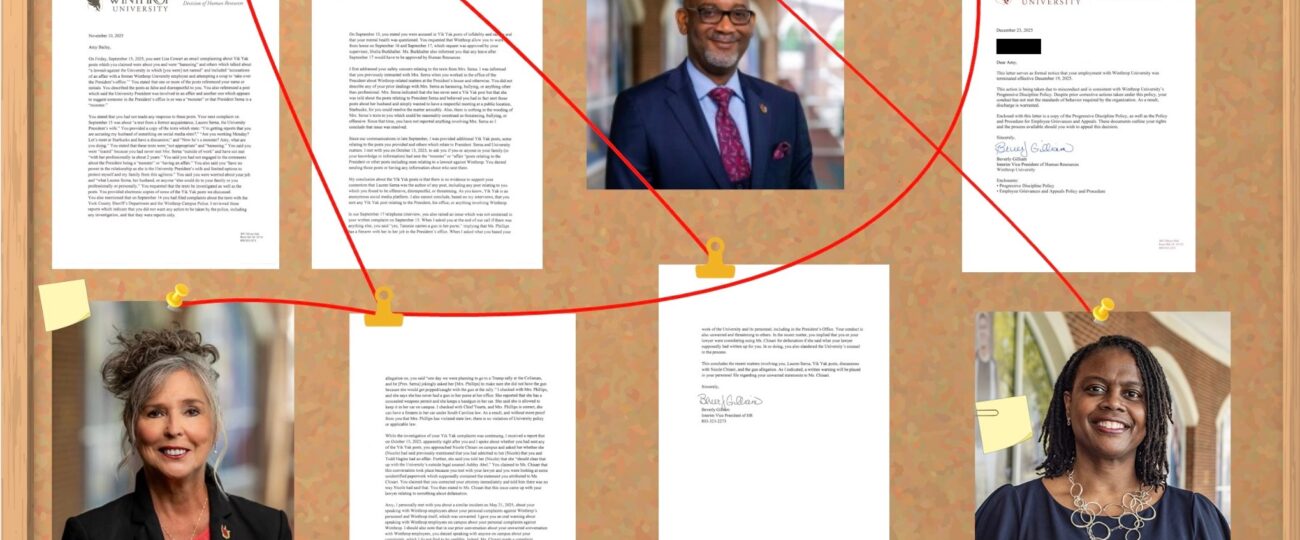
Documents obtained by The Johnsonian detail some of the interactions Bailey had with Winthrop administrators in the months leading up to her termination. In one instance, a written document on November 10, 2025, Gilliam, the Interim Vice President of Human Resources, issued a warning to Bailey.
This warning followed an interaction between Bailey and a colleague, Nicole Chisari. During this conversation, Bailey spoke with Chisari about the affair rumors between Bailey and Hagins. According to the document, Chisari immediately reported the conversation to Human Resources.
Gilliam says that Bailey “implicitly threatened Ms. Chisari with defamation.” The interaction between Bailey and Chisari was further characterized as “unwanted and threatening.”
Bailey was explicitly instructed by Gilliam not to discuss any legal claims against Winthrop with Winthrop personnel: “I want to be clear: do not discuss anything about your legal claims against Winthrop or its personnel with any Winthrop employee.”
Gilliam goes on to explain that such behavior interferes with Winthrop’s workplace and impedes operations: “It unduly interferes with the work of the University and its personnel.”
Bailey’s EEOC also mentions rumors of an affair between herself and Hagins.
However, Bailey argues that it is illegal for her to be told that she cannot discuss the EEOC with colleagues or to be written up for violating a restriction on discussing the EEOC.
“Even if Winthrop has a policy that I can’t talk about the EEOC, my federal rights supersede any policy on campus,” Bailey said. “There’s nothing, policy wise, that says you can’t talk about it. It’s illegal.”
Bailey argues that Winthrop’s instruction raises legal concerns under EEOC anti-retaliation protections. Employees are guaranteed a right to “protected opposition.” However, these protections are fact-specific.
According to the U.S. Equal Employment Opportunity Commission, “Talking to coworkers to gather information or evidence in support of a potential EEO claim is protected opposition, provided the manner of opposition is reasonable.”
Whether Bailey’s restriction was illegal is a matter that would need to be decided in a court of law. No legal injunction has been filed by Bailey or her counsel at the time of publication.
The Johnsonian requested a comment from the University pertaining to this particular complaint, but did not receive an answer by the time of publication. Any future response from Winthrop will be shared to The Johnsonian’s website.
Bailey’s other misconduct charge allegedly resulted from a conversation between herself and a colleague, Kevin Sheppard, Winthrop’s Title IX coordinator and ADA Compliance officer. Bailey alleges that Sheppard approached her to ask how she was doing. This prompted Bailey to comment on alleged double standards in University policy.
Bailey compared disciplinary conduct against Sheppard–it should be noted that Sheppard received a three day suspension for comments made online–to Winthrop’s treatment of Phillips, who received a promotion despite Bailey and Hagins’s complaints of alleged racism.
Bailey recalled telling Sheppard, “I don’t understand how you get suspended for three days because of hate speech, but Tammie Phillips says hate speech and she gets promoted.”
Bailey alleges that Sheppard reported the conversation to Human Resources. According to Bailey, Sheppard’s complaint constituted the second and final instance of misconduct justifying her termination under the University’s Progressive Discipline Policy.
The Johnsonian reached out to Sheppard about the alleged conversation between himself and Bailey, but did not receive an answer by the time of publication.
Legal and financial stakes
Bailey said her termination reflects a system designed to protect administrators from whistleblowers. “You’re HR. You’re supposed to support us,” Bailey said. “I’m coming to you for help, and you’re twisting it and working to get me fired.”
These legal disputes have resulted in financial costs for Winthrop. Bailey alleges that the University has spent upwards of $300,000 on outside counsel to defend itself against her legal claims.
The University has not confirmed Bailey’s estimate. Winthrop has not identified any expenditure as evidence of wrongdoing. In October, The Johnsonian reported that Winthrop paid Abel Law Group approximately $139,853 according to invoices between January 1, 2024 and August 2025.
On top of the legal costs, a Tort Claim Notice filed by Hagins is currently seeking relief for lost salary and benefits in excess of $300,000. These costs come at a time when Winthrop’s finances are under scrutiny from students and administrators.
Conflict between Bailey and the University has also come up regarding access to Bailey’s personnel file. In an email dated January 21, Gilliam told Bailey’s attorney that “Winthrop is not obligated by applicable law or University policy to provide a copy of its personnel file relating to your employment but will nevertheless consider providing documents pertinent to your discharge.”
In a written statement provided to The Johnsonian on January 26, Ellen Wilder-Byrd, Associate Vice President for University Communications and Marketing, said on behalf of Winthrop, “It is not true that Ms. Bailey has been denied a copy of her personnel file.”
At the time of publication, Bailey insists that she has not received her personnel file.
Bailey has not taken legal action against the University personally. According to Bailey, she cannot sue Winthrop until the EEOC concludes its investigation into allegations of misconduct and discrimination.
However, Bailey is not opposed to legal action against Winthrop or individual employees. “What I’ll do moving forward depends on what the EEOC does. But I’m not opposed to suing them.”