

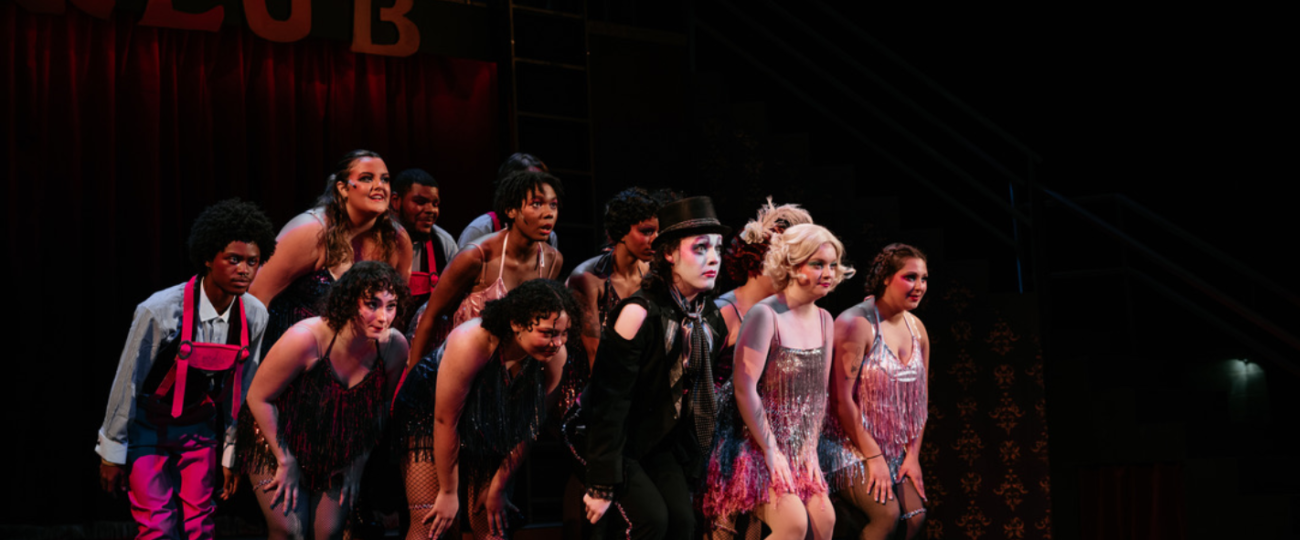
Winthrop Theatre brings drama, romance and political tension to the stage.
By Dakota Gold
Staff Writer
Arts, Culture & Technology
On Oct. 7 to 11 at the Johnson Theatre, Winthrop’s Department of Theatre and Dance performed the award-winning musical “Cabaret.” The show brings the audience back to the Kit Kat Club in 1930s Berlin, Germany as the Nazi regime began to rise into power.
It portrays themes like anti-Semitism, censorship and social compliance. The audience follows the romance between American writer Cliff Bradshaw and English cabaret performer Sally Bowles as they experience the growing impact of political extremism in Berlin.
Rachel Dawson who is the director of “Cabaret” and an Assistant Professor of Musical Theatre and Acting said that the musical is a warning tale.
“It reminds us that when we forget history, we are doomed to repeat it. Set in Berlin during the final years of the Weimar Republic, ‘Cabaret’ introduces us to a world of artistic freedom and expressive living. Berlin was a global hub for queer culture, community and scientific research, and the Kit Kat Club celebrates this spirit of liberation,” Dawson said.
She explains that Berlin club culture in the late l920s and early 1930s was a hub for political satire, using performance to challenge social conventions and reflect political realities. “Beneath the glamour and celebration, however, the threat of rising fascism grows,” Dawson said.
As someone who performed in this show in the past, Dawson noted how the experience stuck with her. She believes it is important to not only tell stories like this to audiences, but also to produce them for students.
“Working with emotionally charged material like this teaches students valuable skills they can carry throughout their careers. They learn how to establish and maintain boundaries when working with challenging content, how to research the people they are representing and the historical circumstances surrounding their stories, and how to engage with that information thoughtfully and respectfully,” Dawson said.
She said that students learn the importance of stepping into roles that may exist outside their own moral compass in order to tell the story honestly, and that this work is about honoring those who experienced these tragedies and those who continue to face persecution today.
Henry Proctor, a sophomore choral music education major, plays Cliff Bradshaw in “Cabaret.”
“I felt that my performance in Cabaret was a step up from my past performances in several regards. The process of finding and developing Cliff’s character was more thought-out and extensive than that of any other role I have played. Many of my castmates have expressed similar feelings. The heart, care, and dedication everyone involved poured into their performance made this show a truly special one,” Proctor said.
This was Proctor’s first faculty-produced show at Winthrop. Although he is not a theatre major, he performed plenty of shows in high school and wanted to carry his passion into college.
“My wonderful castmates, the crew and directors, however, helped me realize that I did in fact belong. […] I wanted theatre to be a part of my collegiate experience. Telling Cliff’s story and the story of ‘Cabaret’ was a fantastic fulfillment of this hope,” Proctor said.
Proctor agrees with Dawson that the show serves as a warning to the audience.
“In ‘Cabaret,’ we see what happens when a society is complacent. Though it was written over 50 years ago, the themes and messages presented in ‘Cabaret’ still can and should be applied today. Shows like ‘Cabaret’ remind us that in our current global and political climate that complacency and inaction are no longer options.”
Dawson shared that she feels a great deal of privilege, honor and responsibility in leading this show. She describes it as a celebration at times, but a warning at all times.
“Guiding our students through this process has been an honor, and I feel proud of their work and their willingness to lend themselves to sharing a story whose purpose is to build empathy and awareness,” Dawson said.
Even through the emotional hardships presented in the material, her students rose to the occasion.
“They embraced what I was asking them to do, stepped into the work with care, and grew through the process. Artistic growth is not separate from our growth as people. It is an honor to witness it.”
Dawson said that the harrowing content the show engages left audiences with what they described as a gut-wrenching experience. She said this is hopeful as it means the story is reaching people and asking them to sit with uncomfortable truths.
“It is important to produce shows like this because acknowledgment without action falls flat. Seeing injustice is not the same as confronting it. Recognizing the warning signs is not the same as responding to them,” Dawson said.
She believes students benefit immensely from performances that challenge them to think critically, feel deeply, and engage with difficult questions about history and humanity.
“Throughout this production, I have been struck by the metaphor of a runaway train. We know the destination, but we cannot get off until someone acknowledges where we are going. The train is already moving, and the longer we ignore its direction, the harder it becomes to change course,” Dawson said.
“‘Cabaret’ reminds us that history is not simply something that happened to other people, in another place, at another time. Its warnings are still relevant, and it is up to us to decide what we do with them.”