

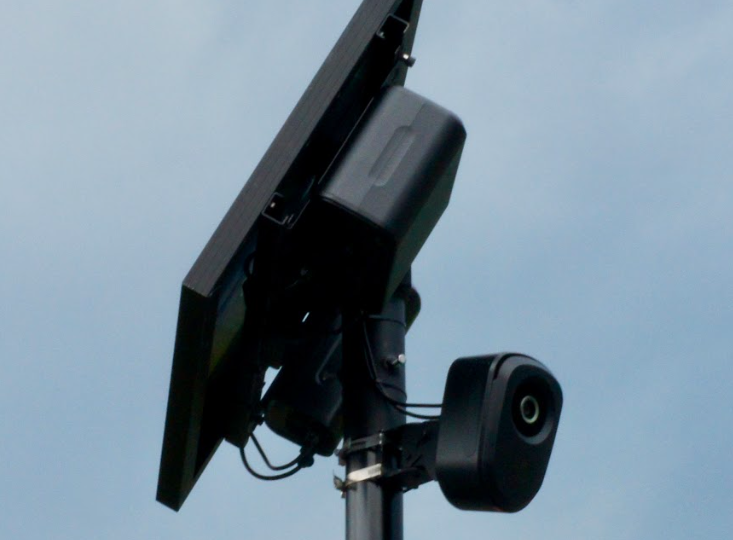
York County is concerned about their privacy, leaving students worried.
By Hudson Mize
Staff Writer
News
A petition to remove Flock surveillance cameras from York County is on the rise as more residents vocalize their disinterest in them.
The petition located on change.org with over 2,400 signatures calls on local governments and law enforcement agencies to remove the cameras which use an automated capture system to tag license plates and help law enforcement investigate crimes.
Supporters of the petition say the cameras violate privacy, are easy to abuse, and store personal information. Law enforcement argues that the cameras help identify suspects and aid in arresting offenders.
Flock cameras began working with Homeowner Associations (HOA) in 2017, originally for private neighborhood safety. In 2020, Flock pivoted to starting contracts with law enforcement agencies to create an interconnected surveillance network.
As of July 2026, Flock has their cameras in 49 states in 6,000 communities, having partnerships with over 7,000 law enforcement agencies.
Brayden Brazil, a Winthrop sophomore and theater major, said he is against Flock cameras because they can be abused by police officers to commit criminal actions.
“Supposedly Flock cameras tag license plates whenever a car passes by, but I know they’ve been used for other purposes,” Brazil said. “I’ve heard that police officers will go and look at their ex-wives and stalk them to see where they are going, but that’s one of the main reasons I’m against them.”
Brazil refers to a CNN article released on Aug. 26 which covers an officer that was arrested in Kentucky for stalking his ex-girlfriend over 2,000 times. A similar case happened in early August, with a Mooresville, NC officer arrested for stalking her former relationship using Flock cameras.
Winthrop senior and mass communication major Joshua Prevette said he believes the data from Flock cameras is being used to support data centers and spy on the general public.
“I have heard [Flock cameras] being abused more in a Big Brother style, very similar to George Orwell’s 1984, than I have any [helpful] use, all I hear is how they’re being used to fund data centers,” Prevette said. “I’ve heard people have illegally used Flock cameras to aid in the capture of immigrants, I’ve heard that ICE uses them.”
Former Winthrop senior and art history major Matthew Hensley said he has concerns over the violation of privacy regarding where the cameras are placed.
“Multiple times I’ve seen online of Flock cameras pointed at pools, or parks, somewhere that it doesn’t need to be,” Hensley said. “I understand that, maybe, they want to try and catch a suspect or perpetrator in action, but constantly being [under] surveillance and wondering if my life is being sold scares me.”
Prevette said he also worries about his data and whereabouts being sold to companies for profit.
“If a Flock camera catches me going back to my apartment with Walmart bags, then suddenly I’m going to start getting more Walmart targeted ads, or deals, or such,” Prevette said.
Matthew Chavis, Public Information Officer at the Rock Hill Police Department, said that Flock provides safety benefits to the public by capturing, not tracking, license plates in order to send out timely alerts in the event of a dangerous crime.
“Flock does not track license plates, they capture the plates as they go by the camera, it is not like GPS tracking,” Chavis said. “In law enforcement we have alerts, what that does is when a car travels past a Flock camera an alert is sent clarifying a car has passed a camera, only if a vehicle has a license plate that must indicate an alert.”
For example, an alert would be used when the police department knows the license plate of a vehicle during an amber alert. The flock cameras would capture the vehicle as it passed by the camera, sending a ping to the station which would direct the officers where to go.
Chavis said that tagging a vehicle to track them could also be done manually. This is how the officer in Mooresville who stalked her boyfriend was able to track the vehicle she wanted.
“They probably went into the system and entered that tag,” Chavis said.
The Rock Hill public information officer said that Flock can only capture vehicles, not people.
“It does not capture people, or bicyclists…you don’t even see the people inside the car if a capture is taken.”
Despite Chavis’s and other defenders’ arguments for the benefits of Flock cameras, the petition claims there have been times when the system has failed. It showcases a current lawsuit in which a man’s license plate was incorrectly identified by a Flock camera in York County, leading to an unwarranted traffic stop and an officer holding the man at gunpoint.
York County resident William McCaskill said that Flock is an unfortunate but necessary tool towards mitigating crime and capturing criminals.
“It is a necessary evil,” McCaskill said. “There is already no expectation of privacy in public, if Flock cameras only do what they are meant to do then I don’t see the issue. If I had proof that they were selling my data or habits or whatever, then I would be more than happy to have them gone though.”
Currently York County does not disclose any information regarding Flock cameras, such as the contracts, cost, or the data shared between the police department and the agency they have the contract with.
“If our money are going to these cameras, then I feel like I should have a right to know what is being used, I should know exactly what the cameras are picking up or registering,” Prevette said.
There are currently 26 Flock cameras in Rock Hill (5 of which surround Winthrop’s campus, one of them being at the coliseum) and 19 in York that are active.


