
Winthrop debuts two student-made sculptures at Rock Hill’s Miracle Park.
By Kyan Feser
Staff Writer
AC&T
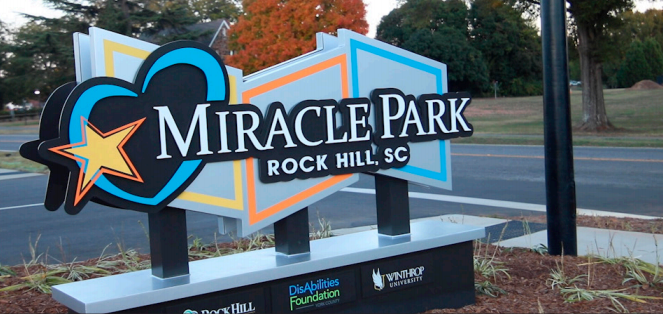
When visiting Miracle Park, Rock Hill’s state-of-the-art accessible playground, guests can view two newly-installed sculptures made by fine art students at Winthrop.
The park’s developers wanted an interactive art piece to thank its donors, so a developer reached out to Shaun Cassidy, the professor of fine arts at Winthrop.
Miracle Park collaborated with Winthrop students in the past. The commissioner was an old student of Cassidy’s, and this time she suggested a class-wide project, Cassidy said.
“They came back to me and asked if I would be interested in working with a class on projects for the second phase of Miracle Park,” Cassidy explained.
“They wanted sculptures that would function not only as interesting visual landmarks and objects, but also as a way to recognize the 200 donors that donated money to Miracle Park.”
After more than two semesters, Cassidy’s intermediate sculpture class debuted “Sponsor Trees,” two sculptures unveiled at Miracle Park this June. Collaborating students included Forest Rain, Gracelynn Mixon, Jesse Gross, Ken Stiles, Maria Emery, Oliver Bartow, Samuel Pach and Zoe Gumangan.
The to-scale, steel, blue powder-coated trees don metal leaves with the names of donors on them, swaying in the wind for park-goers to see.
“We looked at all the parameters. I gave them drawings of what the site was going to look like, and we looked at where potentially we could put sculptures. We spent a lot of time brainstorming what kind of things we could make,” Cassidy said. “We came up with lots of different things.”
Not only was the class involved with the design process, but also the logistical elements of the piece. Students would present their work to Miracle Park, receive feedback, and make changes.
“How is this thing going to be safe? How are kids going to interact with it? How is it going to be within the budget? Can we build it within budget? Can we build it on time? Do we have the technical skills to build this thing? Will it not blow over in the wind? All those kinds of things,” Cassidy said.
For the students involved, it was a great learning experience, according to Zoe Gumangan, a fine arts major and one of the sculptures’ designers.
“We always talk about the artistic side of making, but now we have the hands-on experience of actually having to work with whoever’s commissioning you, working within city regulations and public art,” Gumangan said.
“Sean always says, whenever you have a client, you really got to work with a client.”
This communication was one of the main challenges of the project, Gumangan added.
“It’s not that they don’t know what they want; it’s more so they know what they don’t want, so it’s your job as the artist is sort of like, explain to them, and in the best way, whether it’s visual, words, meetings, whatever, what the final product will be.”
Fine arts major Jesse Gross also worked on the Miracle Park sculptures, and said that the sculptures also look great in a student’s curriculum vitae (CV), an art student’s equivalent of a resume.
“I did learn a lot about, for lack of a better word, problem-solving, because we did hit a lot of road bumps where they wanted to change the design or the colors or the size, or we had to reformat because there were more donor names. It taught me a lot about figuring that type of stuff out,” Gross said.
It was also refreshing to be paid for a project, Gross added.
“There’s not a lot of student artist opportunities,” Gumangan said. “You can get internships, you can volunteer within the community, but it’s really hard to get paid as a student artist on this stuff.”
Cassidy agreed with this sentiment.
“I think there’s a huge misconception about studying art, fine arts in art school. When I went to art school, no one ever talked about money, no one ever talked about how are you going to make a living, how are you going to survive as an artist, and I think Winthrop’s done a very good job of trying to demystify the financial or commercial aspect of having a fine arts degree,” Cassidy said.
These real-world skills, getting paid for the work, were Cassidy’s favorite parts of the project, he explained.
“The thing I like the most is, I like students to understand their creative skills, their creativity, their imagination, their technical skills, their ability to ideate, that has value in culture, right? So they were all paid. The students were all paid by Miracle Park to make these models, to make the final sculptures.”