
The park, which is partnered with Winthrop, is currently under construction to add more accessible spaces for everyone to enjoy, including a retail building, more fields to play on and an indoor programming space.
Caroline Smith
Staff Writer
Since Miracle Park’s grand opening on September 18, 2021, there has been a high volume of activity coming to this destination park. According to a 2024 statistic from miracleparkrockhill.com, “Residents from 41 states visited the park!”
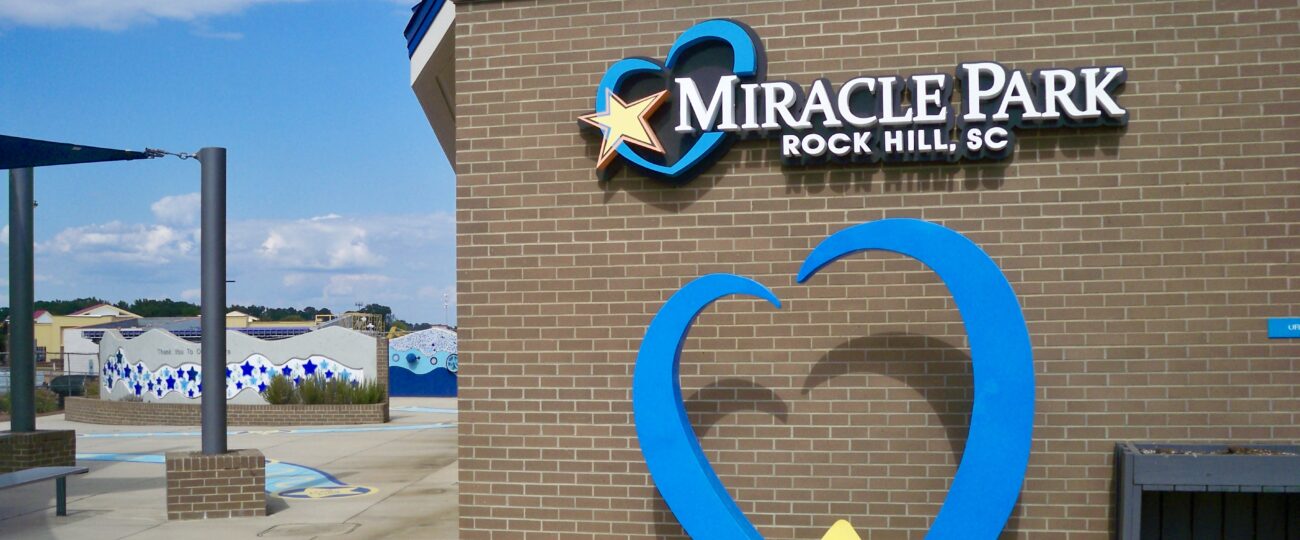
Miracle Park is an all accessible park located in Rock Hill, across the street from the Winthrop University Coliseum. It is open to the public and accommodates children and adults of all abilities who are challenged with standard playground equipment. One key feature is that it is not only compliant with the Americans with Disabilities Act, but conforms to the Global Universal Design Gold Level.
This essentially means that the products that went into making Miracle Park have been looked at from an accessible-to-all perspective, and that all the possible scenarios that a person with accessibility issues may struggle with have been taken into account. For example, the park features smooth and flat sidewalks with minimal inclination, making it easier to walk or ride on for wheelchair users.
The newest additions are Phase Two and Three, which are being built simultaneously. Phase Two is spotlighting more fields for sports, both for the Miracle League and for multipurpose, with special surfaces that are wheelchair friendly.
A therapeutic catch-and-release fishing pond that will be closed to the general public will teach individuals who wish to learn how to fish and the skills that it takes to fish in the retention pond.
Constructing areas for leisure walking, a building to house maintenance affairs, and expanding parking spaces are also under the umbrella of Phase Two. A key feature of this phase is the Education Center, which will allow indoor opportunities when the weather conditions are less than desirable.
Not only does the park appeal to outdoor enthusiasts, but also to those who prefer indoor activities. From art and educational programs to special events and game nights, this park is all-inclusive.
Phase Three is predominantly dedicated to the construction of the 8,200 square foot retail facility. This park not only accommodates those with physical disabilities, but also those who struggle to find jobs as well (who have a intellectual disabilities), and places an emphasis on workforce development that allows more access to adults who wish to build resumes.
To bring more accessibility to the table, a “Retail Building” for the sole purpose of providing resources to everyone who has not yet found their place in the workforce has been added to the plot. Which facilitates “positively helping support workforce development,” Alice Davis, Executive Team Member for the Miracle Park, said.
Additionally, the Retail Building will be specially used for workforce development, with four bays where various workshops will be offered, and workforce educational opportunities, which will be owned and run by Maxabilities of York County. One workshop that will be offered is the process to build a resume.
Although the Retail Building is separate from the park itself, “it’s all encompassing as well,” Davis said.
“This project originally was going to be around three million dollars. It’s now a $14.5 million dollar project. The park piece, including Phase One costs $11.5 million and then the retail space is in addition to that,” Davis said.
In contrast, when Phase One was built the cost was only $5.9 million. Initially this Phase included infrastructure on 15 acres, with interactive aspects that apply to all ages.
When asked about the weaknesses or something that could be improved on Davis said, “The fact that people don’t realize that we have to privately fund this park and so it’s really hard on our volunteers to raise this much money. And so the weakness is people knowing it is a private and public partnership, and that it takes private donors to fund the project operated and maintained by the City of Rock Hill.”
Winthrop’s partnership as well has played a pivotal role in the construction. The park is situated on eight acres of land leased specifically for the park’s usage, with other land leasing donors included in the process.
“Winthrop was behind it from day one,” Davis said. She emphasized how much support this park has gained on a much larger scale (From the University?), tying the community together in such intertwined ways.
The entire team that has come up with the idea and plans for Miracle Park is an all-volunteer group of extraordinary people. Due to the team being composed of only willing people, a serious deficiency in funds has made itself known as a problem.
Although that is a downside to being privately funded, the atmosphere is still strong. “[It’s a] great play arena not just for the kids, but for the adults too. I take them to some parks and just sit in the car to watch them, this is much better being in the park and watching them. They love it here and don’t want to leave,” Dawn Smith, a grandparent and first-time visitor to the park said.
“You know, typically, whenever they are out here, and they are enjoying it as much as everybody and anybody, so to see that inclusivity and to see all people being able to play together. I just—I love that,” Davis said.
In the last four years, Miracle Park has grown on such a grand scale. When asked where she sees the park in five years, “Oh—worldly known. This is a park unlike anything in the United States. There are other parks that have pieces of what we have, but nothing that’s all encompassing together in such a location that we have as well. There are places around the world that know we’re developing this, but once this opens it’s going to become a destination point,” Davis said.
Miracle Park has become a frequently visited place in the past few years. There is only forward from here, and the team has huge hopes that it will keep growing in size and popularity in the coming years.