
City officials agree to short-term agreement with the York County as sale of historic building looms
By: Zachary Bell
Managing Editor
ROCK HILL – Local artists received a surprising extension on their lease at the historic Tom S. Gettys Center in downtown Rock Hill. News of the extension follows a summer of uncertainty for artists after city officials put the Gettys Center up for sale in January.
Artists will be allowed to remain in Gettys, according to a June 13 letter from city officials addressed to the York County Arts Council.
Prior to this extension, the city had instructed artists who worked out of Gettys to vacate the premises by the end of August. But city officials entered a month-to-month lease agreement with the York County Art Council beginning in September.
At the time of publication, Rock Hill city leaders have not publicly spoken about a buyer. Under the new month-to-month lease agreement, city officials will give Gettys’ tenants a two-month notice to vacate the building should the building be sold.
The relationship between Rock Hill’s art scene and the Tom S. Gettys Center goes back over 40 years when the city rented the building to the Arts Council. Today, the old post office is divided between the Arts Council and the Solicitor’s office.
Constructed in the 1930s, the Gettys Center’s advanced age has led to higher maintenance costs that are untenable, according to city officials. Rock Hill put the building up for sale in January for $2.2 million.
The Tom S. Gettys Center is a one of a kind location in Rock Hill. Art galleries that are free for visitors, pottery classes, concerts and theater productions, and the opportunity to connect directly with local artists cannot be easily replicated in another location.
For artists like Dylan Bannister, a Winthrop alumnus and advocate for the arts, Gettys represents more than just affordable studio spaces.
“I think the Gettys Center stands as a reminder that anyone and everyone can be a friend of the arts, [and] can be a creative individual,” Bannister said. “They all have that innate ability. It’s an access point for people to connect with their creativity.”
Bannister, other artists, and community members regularly attend City Council meetings to urge officials to reconsider the sale.
“We want to invite city leaders to–instead of hearing about all the uses of the building and its impact on this community when we go and speak to them at City Council meetings–come see it in person,” Bannister said. “Truly, I think they can understand why we’re so persistent in trying to find that solution that works for everybody.”
Part of the Art Council’s mission is to support local artists by offering studio space at the Gettys Center. On the second floor, the former federal courtroom has become an event space for live music, weddings, and plays.
This event space is an important part of the annual Don’t Sweat It Festival in downtown Rock Hill, hosted by Mike Gentry, a Winthrop alumni who is Winthrop’s Director of Galleries. Don’t Sweat It Inc. is a nonprofit founded by Gentry that organizes annual live music events with the Arts Council.
However, uncertainty surrounding the future of Gettys is making it difficult for Gentry and other artists to plan for the future.
- Michael Simpson operated his gallery out of Gettys’ basement for 25 years, but relocated to East Main Street after Rock Hill’s decision to sell Gettys. For some artists, it isn’t as simple as moving out and finding another venue.
For Bannister, Gettys’ location in the downtown area is a golden opportunity for Rock Hill’s creative scene.
“There’s a big difference between the consumable art experiences, versus a grassroots art community working right within your community,” Bannister said. “Things like what the Rock Hill Pottery Center is doing is gold.”
In 2015, the South Carolina Arts Commission named downtown Rock Hill as the first state-recognized cultural district in South Carolina. Bannister partly attributes this achievement to the work being done in Gettys, and efforts made by the York County Art Council to nurture Rock Hill’s creative scene.
Although Rock Hill supports the arts outside Gettys with projects like Storyline, an outdoor park that will connect Fountain Park to Winthrop, as well as murals and public art installation, Gettys’ convenient location makes art more accessible for the community, according to Bannister.
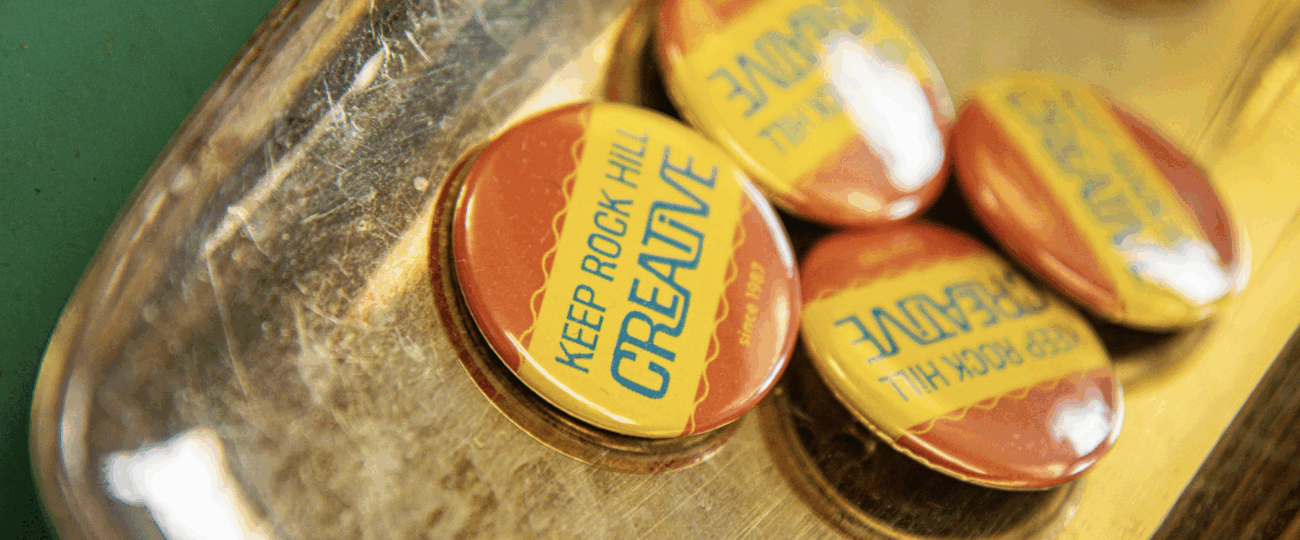
Earlier this year, Bannister, alongside other advocates for the arts in Rock Hill, rallied around the banner “Keep Rock Hill Creative.” On social media and in council meetings, artists fight for Rock Hill’s creative scene.
“That’s why we’re fighting so hard,” Bannister said. “We’re not fighting against anyone. We’re fighting for the cause of retaining the building, and keeping the arts alive. If you keep Rock Hill creative, you keep it hospitable, you keep it fun, you keep it family oriented.”
Despite Gettys’ uncertain future, many artists are determined to make the most of their time. The York County Arts Council continues to lease studios out to new artists, as well as hosting First Fridays Rock Hill, a celebration of local art and culture on the first Friday of each month.
For Bannister, the extension is bittersweet.
“Every day feels a little bit like this could be my last week or month. But there’s a sense of like: I want to bust out as much work as I can while I’ve got it,” Bannister said.
Bannister hopes that Winthrop students will come out to First Friday Rock Hill, or the Don’t Sweat It Festival later in September, and take advantage of the Gettys Center while the creative community has access to it.
“I love my alma mater, and I have a very specific brand of school pride,” Bannister said. “It’s not about basketball and it’s not about Homecoming. It’s the art. It’s the art and it’s the community.”