
Day 4: May 27
This morning we had more time to relax and just lay around after the walk yesterday – something I took full advantage of.
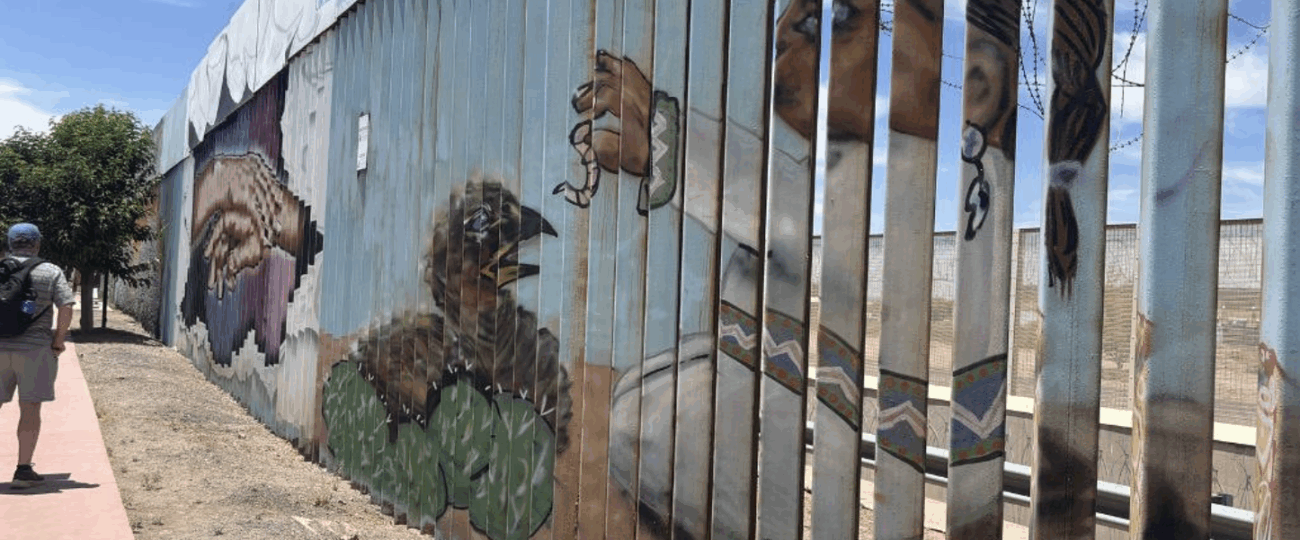
After participating in our daily biblical reflection with Adams, Gallegos took us to the border wall to really examine the mural art – which you can see in the photo story on page 5.
One of the murals that stood out to me was one featuring dozens of monarch butterflies, as I learned that wall construction has significantly impacted their migration.
Monarch butterfly caterpillars only eat this plant called milkweed, and the wall’s construction has wreaked havoc on the plant. This, as you can imagine, affects their migration and reproductive success.
So, not only does the wall impact the lives of humans, but it also affects the very environment we need to survive. Irony at its “not-so”finest.
The walk from the previous day left us all feeling quite sore, so after the prayer walk along the wall and lunch in the plaza we spent more time resting until about 3 p.m. PST.
We trekked back into the U.S. side, which is incredibly easier than driving through. It’s almost exactly like TSA.
After we crossed over, Adams met us to begin our border wall infrastructure tour. During this, we learned about the history of the border wall and just how much of a bipartisan effort it is to keep the wall up.
Some examples include: the Trump administration implementing the concertina wire in 2018, the Obama administration constructing the bollard fence in 2012, and Biden implementing a “Normandy barrier” on the outskirts of the wall during his presidency.
Adams gave us some time to touch the wall and really reflect on it – a moment I’ll never forget. Most people just see the wall through their television, but here I was, face-to-face with a 30 ft wall on top of a mountain. I don’t even think my words can encapsulate its presence.
We then went into the heart of Douglas and met with Bonilla to begin our prayer vigil, where we walked along the road leading into the border patrol checkpoint and held up crosses and remembered those who have died migrating.
Seeing the ages of some of these people was incredibly heartbreaking. I saw people my age and younger and just thought about how much more to life they had to give, and it reminded me of the people in my life that have passed at a young age.
Then I’d see people in their 60s and above, I’d think ‘imagine what they’re leaving behind that they’re this age and trying to seek a better life.’
After collecting the crosses we placed on the side of the road, we went to Adams and Maldonado-Escobar’s house for dinner. After about 3 hours of reminiscing and talking about our life stories, it was time to head back to Lirio de los Valles to call it a night.
Day 5: May 28
After a rather calm day, this day we were set for a jam packed schedule.
We started off having breakfast and reflection at Cafe Justo y Mas, a coffee shop right across the street that’s partnered with Frontera de Cristo.
We ventured deeper into Agua Prieta with Maldonado Escobar after spending most of our time closer to the border or in Arizona.
It was on the drive that I learned brickmaking is a major industry in not just Agua Prieta, but almost all of Mexico. Brick kilns are usually built by hand and with no covering, which has led to pollution across Mexico.
We arrived at our first destination of the day, DouglaPrieta Trabaja – a women’s cooperative that “works to assist individuals and families by establishing and instilling local economic self-sufficiency,” Providence Presbytery states.
The women welcomed us with open arms, and the kids there were so joyful and grateful despite their situation.
DouglaPrieta has had to help teach kids your usual school subjects due to a teacher’s strike in Mexico that started on May 15, 2025. Teachers are seeking a 100% pay raise and for a 2007 law privatizing their pensions to be repealed.
The women showed us around their community garden, which is when I truly got to know the kids there. Two in particular, named Javier and Ana, were tied to my hip and wanted to tell me everything about the garden and also know more about me.
They also put my high school Spanish classes to use, as I can understand it but not speak it back well, but we were still able to understand each other and have a great conversation.
DouglaPrieta teaches the kids there how to sew as well and we got to see the amazing final products. The cooperative sells them in order to help maintain their operation, so I made sure to get an oven mitt for home.
After playing a game of basketball with the kids, it was time to head back to Lirio de los Valles to get some down time.
We ventured back to Cafe Justo y Mas to learn more about the history of the company and their overall purpose.
Major corporations have taken over coffee fields in Mexico and forced them to sell their lands and/or immigrate – another example of how migrants sometimes don’t have a choice.
Cafe Justo y Mas buys from local farmers to keep farmers on their ancestral lands and profit off their product.
We also got an up close look at the coffee roasting process while we were there.
From there we went to a hospitality center for migrants named CAME and met one of the workers. She spoke to us about the center’s history, purpose, stories of migrants who stayed in the past and the conditions they walk through.
We also got to meet a family that’s been there since October 2024. The father, a strawberry farmer, said “he just wants his kids to have a better life.”
Being face to face with a migrant family that has been directly impacted by immigration policies was humbling to say the least. Their heads are still held high despite all they’ve gone through – it made me stop and contemplate the things I complain about at home.
Day 6: May 29
Today was our last full day in Agua Prieta and Douglas, and it was also the day I’d been anticipating the most. We were set to head into the mountains of Arizona to place a cross where a 46 year old man named Ulises Molina Perez died migrating last year.
Before that though, we had breakfast at the house of former border patrol agent Robb Victor. We got to ask him questions about his career and personal views, which you can read about on page 3.
After talking with Victor, we went to the Frontera de Cristo office and met the man who would be leading us on the walk, Gabriel Saspe. Saspe is a Yaqui elder and Catholic deacon.
While we were there, Adams told us many heartbreaking stories about migrants dying in the desert, including crosses being desecrated and a story of a young man who passed away from a rattlesnake bite in the desert. You can read more about that in “Is He Illegal?” on page 8.
When the question of who wants to be the cross holder came about, I immediately knew I wanted to be the one.
As I previously mentioned, I’m not very religious, but honoring the dead and Native culture is important to me.
We departed for the mountains and made it to the site after about an hour of driving.
After digging the hole for the cross, Saspe led us in a Native ceremony to put Molina Perez’s soul to rest. It was one of the most moving and powerful moments of my life.
We gave this man a proper burial and remembered his life, although we did not know him.
This took up a good portion of the day, so when we got back it was almost time for our farewell cookout with all the people we’ve met.
It was bittersweet. While I was ready to go home, I grew to love the community there and would miss their hospitality and camaraderie.
I’m very much a homebody, and Agua Prieta made me feel at home.
Day 7/Epilogue: May 30
We said our goodbyes to everyone and left Agua Prieta at 8 a.m. PST to head to Phoenix airport.
While there were moments on the trip I wondered if it would be worth it, by the end of it, I knew it was more than that. It was life altering.
Being able to interact with the people and see the wall up close, not through a TV screen or by hearing whatever the mainstream media is saying, is imperative if you want to know more about the border.
Is it the chaos that Trump and major cable news outlets claim is happening? Not from what I saw.
Most importantly though, I heard first person accounts of how and why these people are forced to migrate. Some just have to get up and leave on a whim.
I know most people love to talk about those who “do it the right way,” and many want to. But when you strip away so many options that make it easier and also consider the “right way” can still take decades, you’re eventually left with no other choice.
There has to be a process, because we saw the impact of Biden’s lax border policy. But the government makes it harder than it needs to be and based on how the border wall looks in person – I don’t even know if they view them as humans.
But they are, and they need to be treated as such.
I also know some people will read this and roll their eyes or scoff at what I’m saying, and to that all I have to say is: go see for yourself. Not through the screen, not what Sean Hannity, Jesse Watters or Jake Tapper are saying, but in person with your own two eyes.
I want to thank professor Ginger Williams for inviting me to come, along with the OAPC group for welcoming me with open arms.
Most importantly though, I want to thank Mark Adams, Miriam Maldonado Escobar, Joca Gallegos, David Bonilla and everyone else who’s a part of Frontera de Cristo and Lirio de los Valles. They represent what I believe Christianity should be all about, and they give me hope for this world.
If you want to learn more about what FDC does, visit their website https://fronteradecristo.org/